

















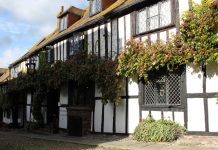

Sussex is famous for the Battle of Hastings in 1066, the chalk landscapes of the South Downs, the Seven Sisters and Beachy Head, Brighton’s seaside culture and Royal Pavilion, and English sparkling wine. Its castles and historic towns add to a reputation built on much more than a summer trip to the coast still favoured by the population today.
The historic county lies in south-east England, and its name comes from the South Saxons. This guide covers East Sussex, West Sussex and Brighton & Hove, from the familiar landmarks to the literary homes, gardens and cultural institutions that help explain why Sussex is known far beyond its boundaries.
1066: Pevensey, Hastings and Battle
On 14 October 1066, William of Normandy defeated King Harold’s army at the Battle of Hastings, a decisive event in the Norman Conquest of England. Yet the battle’s name can send visitors and tourists looking in the wrong place. The battlefield is inland, at what is now the town of Battle, rather than on the Hastings seafront.
William’s forces had landed at Pevensey, where they made use of the surviving Roman defences. Following his victory, William founded Battle Abbey as penance for the bloodshed of the Conquest. The monastery endured for more than 400 years, linking the battlefield with the religious life that developed around it.
Pevensey’s walls tell an even longer story. The Roman fort began around AD 290 and the Normans later built a fortress within it. In 1940, the site was prepared for another possible invasion, with machine-gun positions camouflaged into the ancient defences. Roman masonry, Norman fortification and wartime engineering occupy the same site which is synonymous with the Sussex coastline and beyond.
The South Downs, Seven Sisters and Beachy Head
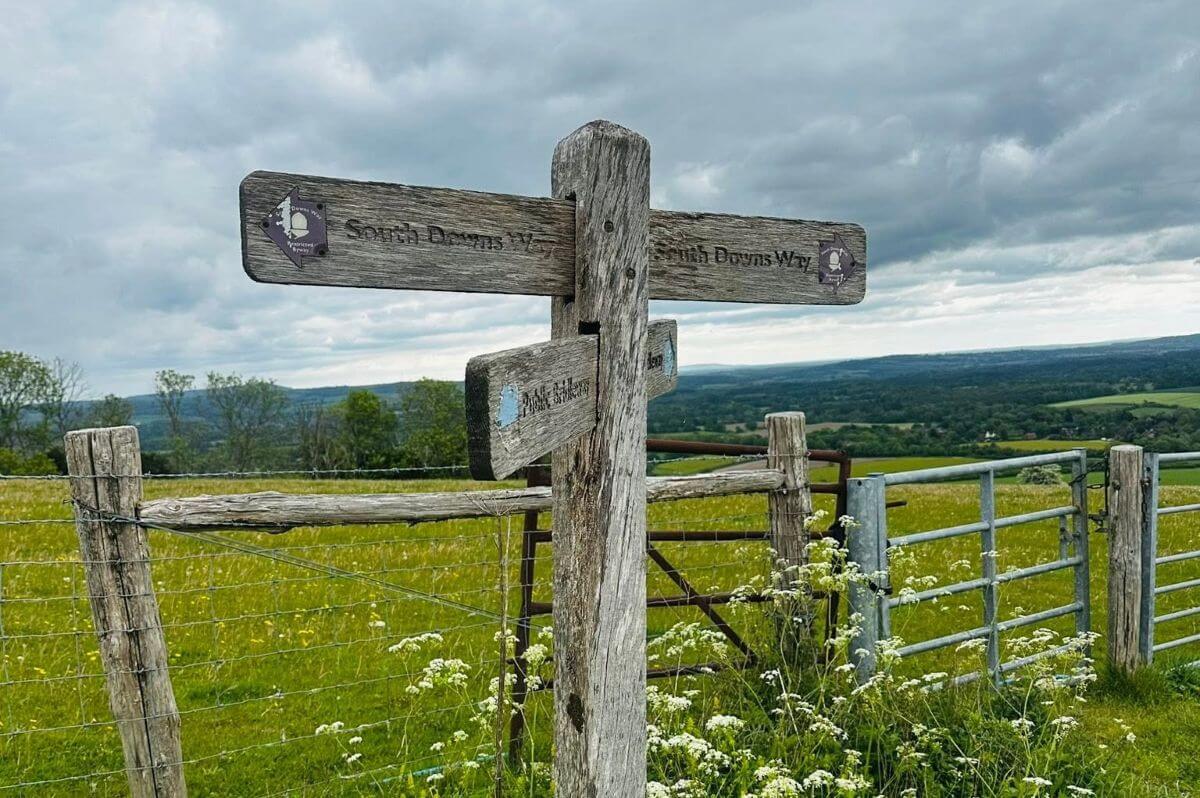
The South Downs are known for rolling chalk hills, open grassland and long views. But the South Downs National Park also contains woodland, heathland, river valleys and working farmland. Its landscapes support wildflowers and butterflies as well as walkers and cyclists.
The South Downs Way runs for 100 miles between Winchester and Eastbourne. That route is a useful reminder that the Downs extend beyond Sussex into Hampshire: the landscape does not begin and end at the county boundary.
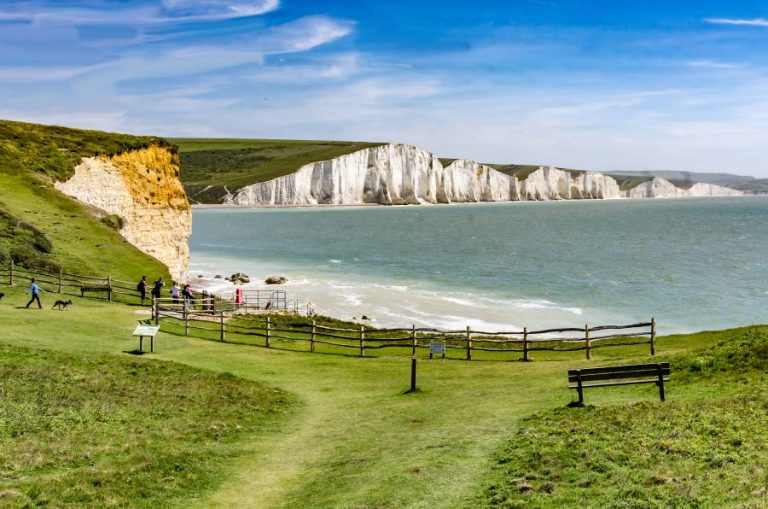
On the East Sussex coast, the Seven Sisters form the succession of white chalk cliffs between Cuckmere Haven and Birling Gap. Their rounded summits and intervening valleys create the familiar undulating outline. Further east, Beachy Head is the chalk headland beside Eastbourne. Both belong to the South Downs coastline, but they are distinct places.
These cliffs are continually changing. Chalk is unstable, and major falls can happen without warning. Visitors should stay well away from both cliff edges and cliff bases, following local signs and safety guidance.
Further west, the coast takes a different form. East Head, beside West Wittering in Chichester Harbour, combines sand dunes, shingle and saltmarsh. Marram grass grows through shifting sand, helping form a fragile coastal landscape quite unlike the chalk cliffs. Sussex’s seaside reputation embraces both.
Monarch’s Way: an escape route through Sussex
Monarch’s Way is a long-distance 625 mile walking trail based on Charles II’s escape after his defeat at the Battle of Worcester in 1651. It begins in Worcester, passes through ten counties before finishing at Shoreham-by-Sea, where the story of his flight from England reaches the Sussex coast.
The Sussex section enters the county at Stansted Park, then passes through West Dean and over the Trundle, with views towards Goodwood Racecourse. Further along, the route takes in Arundel Park, Arundel, Findon and Bramber before eventually reaching Shoreham via Mile Oak and Hangelton’s Devil’s Dyke Trail and the streets of Brighton. These places give walkers a way to explore the trail in sections rather than undertaking the entire journey.
At the coast, the escape continued by sea. Charles reached Fécamp in Normandy from Shoreham in 1651, a connection recorded by Shoreham Port. The trail’s Sussex endpoint therefore marks more than the finish of a walk: it connects the county with his departure for France.
Brighton’s seaside culture and Royal Pavilion
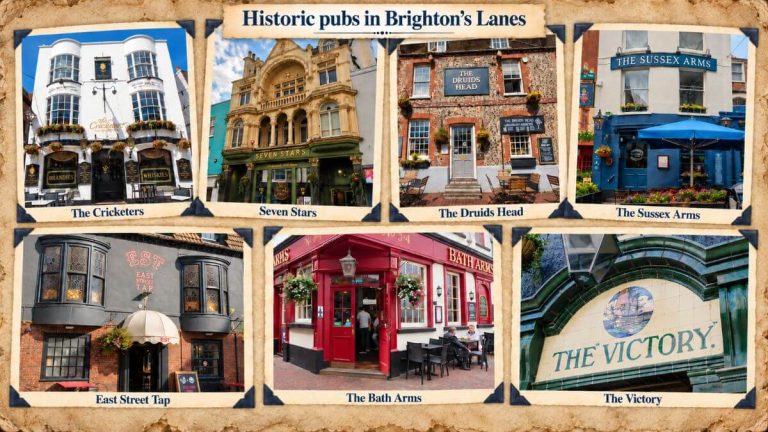
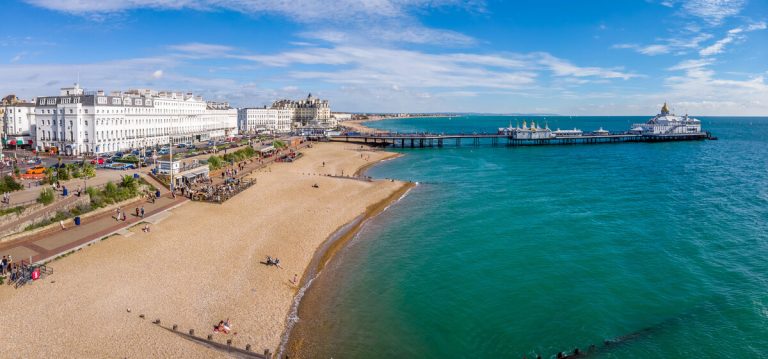
Brighton brings together several versions of the English seaside: the shingle beach and amusements of Brighton Palace Pier, the shops and narrow passages of the Lanes, and the vintage fashion and food businesses of North Laine.
Its most recognisable building, however, began as a royal retreat. In 1815, the future George IV commissioned John Nash to transform his earlier seaside residence into the Royal Pavilion. Nash’s domes and minarets were supported by an iron framework built around the existing structure. Inside, Chinese-inspired decoration reflected the royal interest in imported furniture, objects and wallpapers.
The building’s history later took a very different turn. During the First World War, the Pavilion became a hospital for Indian Army soldiers who had been wounded or fallen ill while serving on the Western Front. Rooms created for royal entertaining were adapted for medical care.
Brighton’s cultural identity continues through performance and public celebration. Brighton Festival and Brighton Fringe bring theatre, music, dance and other arts to the city, while Brighton & Hove Pride celebrates its LGBTQ+ community. These events belong alongside the Pavilion and pier in any account of what makes Brighton (and Sussex) widely known.
Castles with very different histories
Sussex’s castles reward a closer look at their dates. The buildings grouped together as “medieval heritage” often contain substantial additions from much later periods.
At Arundel Castle in West Sussex, the Norman keep survives from the castle’s early history. Much of the residence’s present appearance, however, comes from extensive rebuilding in the late nineteenth and early twentieth centuries. The skyline combines medieval defences with later Gothic architecture.
Lewes Castle, in East Sussex, was built after the Norman Conquest. Its elevated position gives views across the town and surrounding countryside, while the associated Museum of Sussex Archaeology introduces a wider history through objects from prehistoric to medieval times.
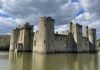
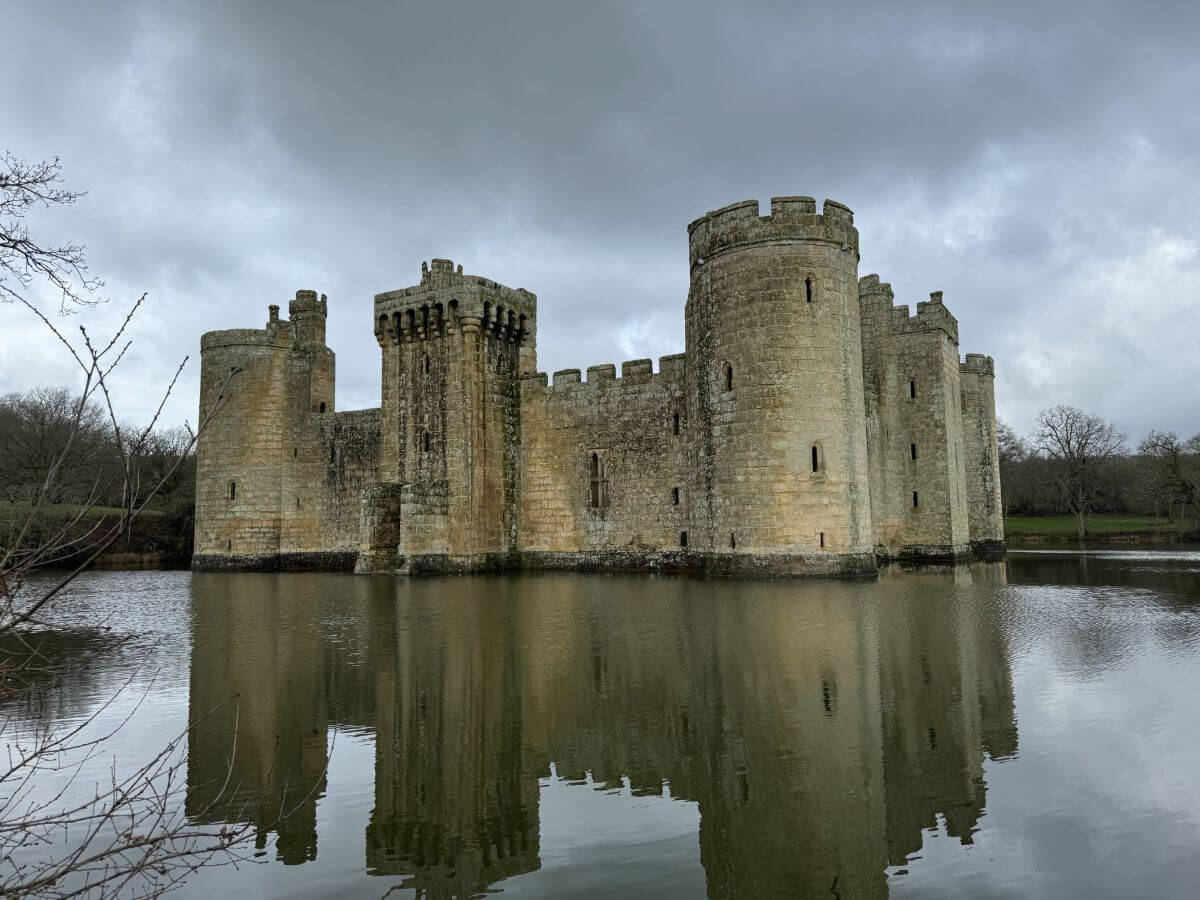
Bodiam Castle, near Robertsbridge, is a fourteenth-century moated castle. Its towers and surrounding water create a remarkably complete-looking exterior, but the interior is ruined. Among the surviving details is an original wooden portcullis, a rare reminder of how the entrance was once secured.
Together, these sites offer different encounters with the past with Arundel’s rebuilt residence, Lewes’s hilltop stronghold and Bodiam’s moated shell.
English sparkling wine
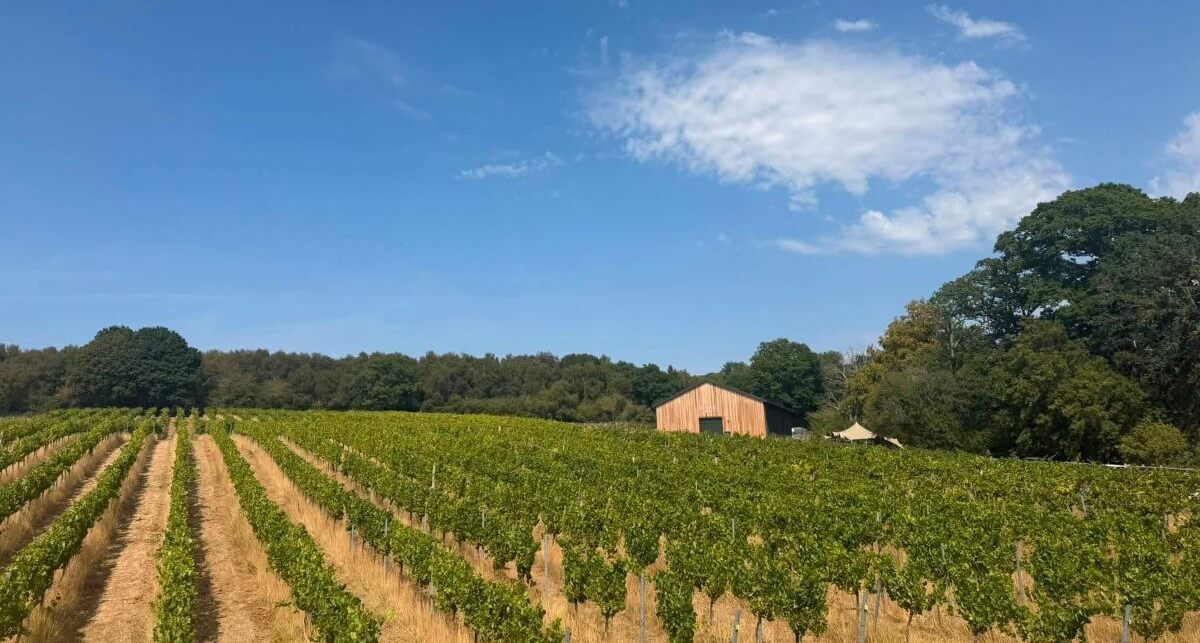
Sussex’s wine reputation is one of its more recent claims to wider recognition. Vineyards now form part of the visitor landscape, with producers offering tours, tastings and, in some cases, places to stay. Sparkling wine attracts particular attention, although still wines are made here too.
The growing conditions help explain the interest. Industry body WineGB describes how the UK’s cool climate and extended growing season allow grapes to develop flavour without becoming overripe. Traditional-method sparkling wine has been central to the industry’s reputation.
There are examples on both sides of Sussex. Rathfinny, near Alfriston in East Sussex, grows vines on south-facing chalk downland and carries out its winemaking on the estate. Wiston Estate, in West Sussex, also has chalk vineyards and its sparkling blends include Chardonnay, Pinot Noir and Pinot Meunier. There are also Bolney Wine Estate, Nutbourne vineyards, Ridgeview, and many others.
The regional name also has a formal distinction. The wine name “Sussex” was registered under the UK Protected Designation of Origin scheme on 5 July 2022. That is a documented milestone behind the name on the label, rather than a general claim that every Sussex wine is superior to wines made elsewhere.
Winnie-the-Pooh and Sussex’s literary homes
Some readers first encounter a Sussex landscape through a children’s book.
Ashdown Forest in East Sussex inspired the setting of Winnie-the-Pooh. A. A. Milne lived on the Forest’s edge, and his explorations with his son, Christopher Robin, helped shape the stories illustrated by E. H. Shepard. Places associated with the books include Galleon’s Lap and Poohsticks Bridge.
The Forest is the real landscape behind a fictional world, rather than a purpose-built attraction. Its custodians note that parts of the landscape have changed, but recognisable places connected with the stories remain.
Elsewhere in East Sussex, the connection between writing and place is more domestic. Monk’s House in Rodmell, near Lewes, was the home of Leonard and Virginia Woolf. The cottage, garden and writing lodge bring the writer’s working surroundings into view. The National Trust identifies the lodge as the place where she wrote much of her major work; Leonard developed the garden, with its orchard and ponds.
At Charleston, the emphasis shifts towards painting. The house was the home and studio of Vanessa Bell and Duncan Grant. Bell was Virginia Woolf’s sister, and the two properties connect Sussex with the writers and artists of the Bloomsbury group.
Bateman’s, near Burwash, preserves another author’s home. Rudyard Kipling lived in the seventeenth-century house, where his study remains a central part of the visit. The surrounding High Weald countryside, with its small fields, hedgerows and wooded landscape, also features in the National Trust’s account of the place that inspired him.
Opera, theatre and the Goodwood hillclimb
Sussex’s cultural reputation also depends on performances and events that bring audiences back year after year.
At Glyndebourne, near Lewes, John Christie and the singer Audrey Mildmay founded the first opera festival in 1934. Its original theatre seated about 300 people. A festival established around a country house grew into an enduring part of the county’s musical life.
In West Sussex, Chichester Festival Theatre opened on 3 July 1962, with Laurence Olivier as its first artistic director. Its opening season did not begin with uninterrupted success: early productions received mixed reactions before Uncle Vanya drew overnight queues for tickets. The theatre’s archive records a special train service taking audiences back to London after evening performances.
Nearby, Goodwood’s Festival of Speed brings a very different audience to the countryside around Chichester. Held in the parkland surrounding Goodwood House, the event combines its hillclimb with displays and demonstrations of racing machinery, road cars and automotive technology. Historic competition cars appear alongside newer engineering, while disciplines including Formula One, endurance racing and rallying are represented.
The appeal is not simply a line of vehicles on display: the hillclimb puts cars into motion, making sound, speed and engineering part of the experience.
Great gardens and a global seed bank
Sussex’s garden heritage includes places that have influenced how people grow plants, and a centre dedicated to preserving them.
Great Dixter, in Northiam, East Sussex, is closely associated with gardener and writer Christopher Lloyd. His work in the garden fed into books and journalism, including The Well-Tempered Garden and a weekly Country Life column that continued for 42 years. Experiments carried out in one Sussex garden reached readers who might never visit it.
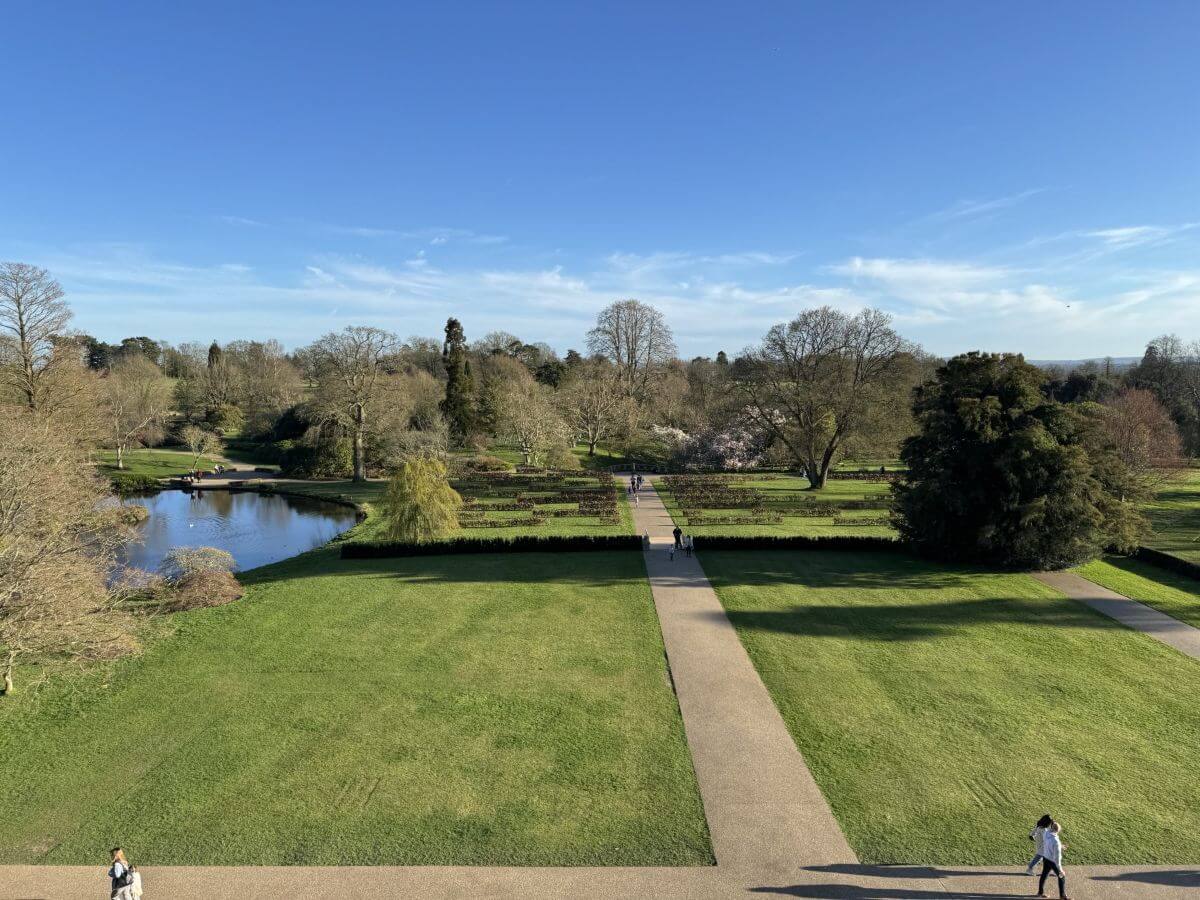
At Wakehurst in West Sussex, the Millennium Seed Bank gives the plant story an international dimension. It opened in 2000, and Kew reports that its collection contains seeds from more than 40,000 plant species. Visitors can see scientists processing and studying seeds through the building’s glass atrium.
The collections support research into how seeds germinate, help scientists study plants and contribute to efforts to restore species to the wild. Kew also works with seed banks and conservation partners around the world. Sussex’s role here reaches far beyond a garden visit: it helps preserve the material from which future plants can grow.
You May Also Be Interested In