





















Brighton & Hove Albion Women won 5-1 as they returned to the Amex to face Charlton Athletic today, as the club works towards a permanent home for the team next door.
According to the BBC, 2,465 fans bathed in glorious sunshine in the East Stand for the Women’s Super League match which kicked off at 2pm on Sunday 4 October, making the most of the opportunity during the men’s international break. It is the second of four women’s league games scheduled at the American Express Stadium before Christmas, with other home fixtures continuing at Crawley Town’s Broadfield Stadium.
The attendance today was a good indicator for the Albion Ladies’ proposed ground at Bennett’s Field providing a dedicated stadium with at least 10,000 seats. Today, the price for adults was £15 and concessions ranged from £6 to £11. MyAlbion+ and Built for Her members receive a 20% discount on standard tickets. Season-ticket holders and members can also book one free standard ticket for a guest without a purchase history.
But the key is the absence of men’s football meaning some would have taken the opportunity to go when they wouldn’t normally. And it’s clear that the level of opposition makes a difference, as the managed likely hoped for a bigger turnout than the Crawley average.
Last season, Brighton’s two WSL matches at the Amex averaged 5,697 spectators, compared with 2,514 across nine games in Crawley, according to the Women’s Football Data Centre. Those figures provide a logical starting point for understanding the scale of the club’s ambition on and off the pitch, with the team finishing runners-up at the 2026 FA Cup final, and 7th in the WSL.
But of course the project is about more than where the team plays, it is also a long-term investment in attracting a larger, more regular audience for the Seagirls (they are not actually called that for reference, it’s still the Seagulls or Albion). And naturally inspiring the next generation of female footballers.
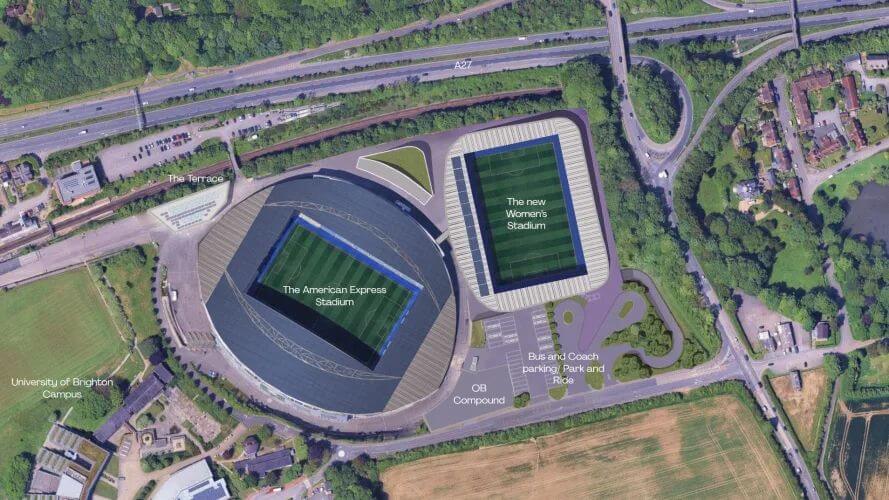
Brighton women’s stadium plans at a glance
| Location | Beside the Amex’s East Stand in Falmer |
|---|---|
| Capacity | A minimum of 10,000 spectators |
| Estimated cost at launch | £75 million–£80 million |
| Opening target | No later than the 2030/31 season, subject to planning approvals |
| Connection to the Amex | A proposed bridge between the grounds |
| Planning authorities | Brighton & Hove City Council and Lewes District Council |
How many people watch Brighton Women?
Not including today’s game. The Women’s Football Data Centre’s completed-season analysis records 34,019 spectators across Albion’s 11 home league matches in 2025/26, an average of 3,093.
Splitting those crowds by venue gives a more revealing picture than the overall average.
| Venue | Matches | Total attendance | Average attendance |
|---|---|---|---|
| Broadfield Stadium, Crawley | 9 | 22,625 | 2,514 |
| Amex Stadium | 2 | 11,394 | 5,697 |
| All home league matches | 11 | 34,019 | 3,093 |
The Amex fixtures attracted 4,645 against Leicester City and 6,749 against Tottenham Hotspur. The proposed stadium’s capacity is above both crowds, leaving room for the growth the club expects by playing in the city rather than 30 minutes up the road.
Of course two matches cannot establish how every fixture at a new ground would perform. Opponents, scheduling, ticket offers and the attraction of an occasional Amex visit all complicate the comparison with a regular programme in Crawley.
At the April stadium launch, chief executive Paul Barber addressed the capacity directly: “10,000 is ambitious, but not over-ambitious.”
In the club’s account of the announcement, Tony Bloom said he expected the new stadium eventually to sell out regularly, while acknowledging that it might not happen immediately. He also envisaged using the larger Amex for exceptional fixtures attracting more supporters than the new ground could accommodate.
And of course it’s more than that. Every Brighton fan knows the power of having a home ground to call your own, and it’s never the same shoehorned into one stand for staffing logistics. And for spectators, the toilet facilities are obviously catering for the men’s matches, and thus woefully inadequate for a higher female attendance as proved in the Women’s rugby matches it’s hosted.
Success on the pitch will translate to increased attendance, and any European competition would create more appeal.
What are average WSL attendances?
The same independent compilation records 904,276 spectators across 132 WSL matches in 2025/26, an average of 6,851 per game.
The differences between clubs are substantial though. Arsenal averaged more than 33,000, while most teams’ averages were below 6,000. That does indicate what is possible for Brighton Ladies.
| Club | Average attendance |
|---|---|
| Arsenal | 33,808 |
| Chelsea | 8,519 |
| Manchester United | 6,178 |
| Manchester City | 5,551 |
| Liverpool | 5,303 |
| Everton | 4,854 |
| Aston Villa | 3,677 |
| Tottenham Hotspur | 3,571 |
| London City Lionesses | 3,176 |
| Brighton & Hove Albion | 3,093 |
| Leicester City | 2,776 |
| West Ham United | 1,702 |
Source: Women’s Football Data Centre and its club analyses. Each club played 11 home league matches. Figures include all home venues, exclude cup games and are rounded to the nearest spectator.
Which WSL teams already have a stadium of their own?
Brighton would not be the first women’s team with a permanent home separate from its men’s first team. Albion describes its proposal as the first stadium in the UK and Europe designed specifically for women’s football, rather than an existing ground adapted for the purpose.
Everton’s move to Goodison Park is the clearest example of a different approach. The women’s team took over the historic ground as its permanent home for 2025/26 after the men moved to their new stadium.
The Goodison decision kept football at an established venue instead of requiring a new build. Everton’s reported average there last season was 3,524 across ten league matches, according to the Data Centre’s analysis. A separate game at Hill Dickinson Stadium drew 18,154. Again, this was in an international break giving fans a cheaper match day experience, especially for those unable to get a ticket to men’s games.
Manchester City have the Joie Stadium, a separate ground on their football campus that also hosts academy matches. Their women’s team uses it regularly while playing selected fixtures at the Etihad.
Chelsea have moved in the opposite direction to Brighton’s proposal. From 2026/27, all 13 of their home WSL matches are at Stamford Bridge, following the move away from Kingsmeadow as their regular league venue. Chelsea’s announcement presents that change as a permanent home at the club’s main stadium.
Arsenal also play all their home WSL fixtures at the Emirates. And it’s no surprise that these clubs mentioned all have the higher attendances, but also happen to be the bigger reputation teams.
Others continue to share grounds with football or rugby clubs, sometimes supplementing that programme with matches at their men’s stadium.
Where the 2026/27 WSL teams play
The division now has 14 teams, so its current stadium list differs from the completed-season attendance table above. These are playing arrangements, rather than a register of who legally owns each building.
| Club | Home ground or grounds | Arrangement |
|---|---|---|
| Arsenal | Emirates Stadium | All home WSL matches at the men’s first-team stadium |
| Aston Villa | Villa Park and selected fixtures at Keys Park | Main-stadium programme with exceptions; the Liverpool game on 18 October is listed at Keys Park |
| Birmingham City | St Andrew’s @ Knighthead Park | Uses the club’s main stadium |
| Brighton & Hove Albion | Broadfield Stadium and the Amex | Groundshare with Crawley Town, plus selected Amex fixtures |
| Charlton Athletic | The Valley | Home league programme at the men’s stadium |
| Chelsea | Stamford Bridge | All home WSL matches moved there for 2026/27 |
| Crystal Palace | Sutton United’s ground, Gander Green Lane | Groundshare rather than an exclusive women’s venue |
| Everton | Goodison Park | Permanent women’s home following the men’s departure |
| Liverpool | St Helens Stadium and Anfield | Regular programme at St Helens, with selected Anfield fixtures |
| London City Lionesses | Hayes Lane, branded CopperJax Community Stadium | Stadium-sharing agreement with Bromley FC |
| Manchester City | Joie Stadium and selected Etihad fixtures | Separate campus stadium also used for academy football |
| Manchester United | Leigh Sports Village and Old Trafford | Regular home at Leigh, with selected main-stadium fixtures |
| Tottenham Hotspur | Brisbane Road and Tottenham Hotspur Stadium | Groundshare with Leyton Orient, plus selected main-stadium fixtures |
| West Ham United | Chigwell Construction Stadium, Dagenham | Uses Dagenham & Redbridge’s ground |

Why does Brighton want a separate ground?
Today’s international-break fixture makes use of a gap in the men’s programme. A dedicated stadium would give the women’s team greater control throughout the season, rather than depending on the availability of the main ground.
At the April launch, Barber explained that the men take priority when dates clash because their fixtures generate substantially more revenue. A separate venue would remove that competition for the same pitch and facilities.
His comments were reported by Sky Sports. The proposed location would also allow the two stadiums to share existing infrastructure, including the club shop and ticket office.
Barber estimated the build at £75 million to £80 million. Bloom said at the announcement that he was not seeking outside investment to fund it. Those were the figures and financing position given at launch, rather than a final construction contract.
While it’s not been mentioned, the smaller stadium also logically opens up other opportunities such as U21 matches (in 2026 they have played at Stoke, Wolves and Norwich), Lioness games, women’s international tournaments in football and rugby, or even Sussex County Cup Finals (currently at the Amex but the last final was a 1506 crowd). Sports aside, there could be concerts or other events too.
Simply, a modern stadium with a capacity of 10,000+ may not sound a high number to some, but the second biggest in Sussex is the Broadfield Stadium at 6,134 but 3,295 seated. For reference, the Withdean Stadium was 8,850 at its peak.
Bennett’s Field was previously approved for student housing
The site beside the Amex has a planning history of its own.
On 6 November 2023, a planning inspector allowed an appeal for 555 student bedrooms on the former Bennett’s Field car park. The scheme comprised two six-storey wings connected by a central two-storey section.
The appeal decision identifies Downing Students and members of the Bennett family as the applicants, following Lewes District Council’s refusal of the original application.
Albion subsequently bought Bennett’s Field in 2025. Its stadium announcement on 28 April 2026 confirmed work on a different planning application, with the site’s slope allowing underground parking and level spectator access.
The student-development permission is not permission for the stadium of course. The club made its 2030/31 opening target conditional on approvals through Brighton & Hove City Council and Lewes District Council.
What would “Built for Her” mean in practice?
The design work addresses facilities beyond the pitch and stands.
A Deloitte analysis published during the project’s earlier development identified more than 30 structural differences being considered between Brighton’s main stadium and its proposed women’s venue. These included individual shower cubicles and additional toilets in the changing-room facilities.
The proposals presented at the April launch also included dedicated recovery spaces, wider concourses, social areas and easier access for families.
Fran Kirby welcomed the project’s potential to attract players and staff. In her response to the announcement, she linked better facilities with the club’s ambitions to compete at a higher level.
A wider Falmer sports zone has been suggested
The stadium also featured in a House of Lords debate on 17 September.
Lord Bassam of Brighton suggested a wider sports zone connecting the stadiums, Brighton Aldridge Cricket Academy and nearby academic institutions, asking about possible enterprise or investment-zone arrangements.
Responding for the government, Baroness Taylor of Stevenage said sports clubs had not been given special enterprise-zone status. She described the stadium regeneration accelerator as a way to coordinate projects and address barriers, not a capital fund for stadium construction.
The debate did not announce an approved Falmer zone or a funding award for Albion.
Turning an Amex visit into a regular habit
While the stadium project develops, Albion is increasing the opportunities to watch the women’s team in Brighton to help build up interest.
The club’s July fixture announcement introduced four Amex league games before Christmas, beginning with Aston Villa on 20 September. A four-match package launched at £45 for adults, alongside membership benefits.
Today’s Charlton fixture also has offers intended to bring new supporters through the gates, and no doubt the drive will continue until the new stadium is opened.
Next at the Amex
Family tickets for Brighton v West Ham advertised at £36
The family option covers two adults and two children in the under-18 or under-10 categories. Kick-off is 5:15pm on Saturday 24 October. Check the club’s ticket page for availability and the conditions of each offer.
Home matches elsewhere in the programme remain at Broadfield, so supporters should check the venue when booking.
A home for the players who follow
Albion hopes the proposed stadium could also host academy and development fixtures, giving younger players experience of the first team’s matchday environment.
For Maisie Symonds, the prospect carried a significance beyond her own career. Speaking when the plans were unveiled, she said: “Knowing that future Brighton players will have a stadium built specifically for them is quite emotional.”
The proposed stadium is a commitment to all aspiring footballers, the city, players and matchday identity the club wants to develop over the coming years.
Local grassroots clubs like Hove park Colts have been working tirelessly to run teams for the next generation of female players and currently have 164 girls registered and playing.
Published on 4 October 2026. Attendance comparisons use reported league crowds for the completed 2025/26 season; current stadium arrangements refer to 2026/27.
You May Also Be Interested In