









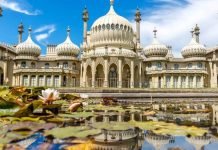





Brighton’s Royal Pavilion is far stranger inside than it first appears from the Pavilion Garden. Behind its domes and minarets are dragon chandeliers, a technologically advanced Regency kitchen, royal bedrooms and the story of a palace that later became a First World War hospital.
The Royal Pavilion is Brighton’s former opulent royal seaside palace, created for George IV and transformed by architect John Nash from 1815.
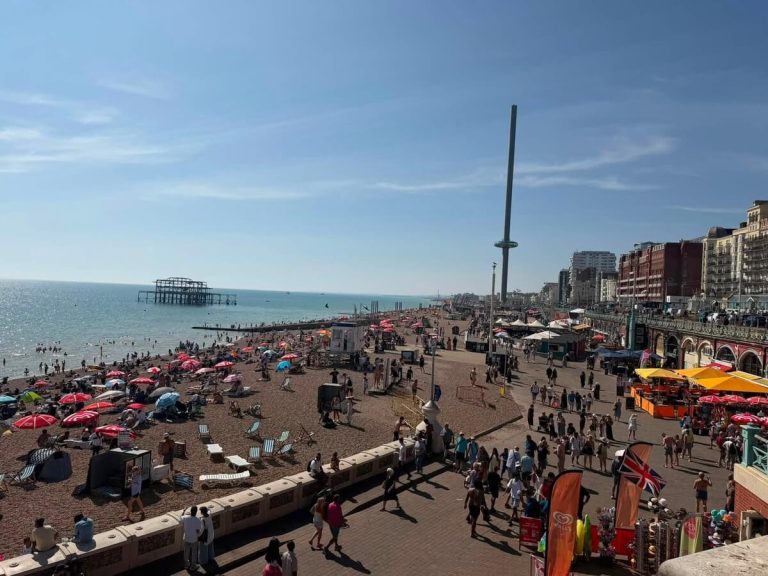
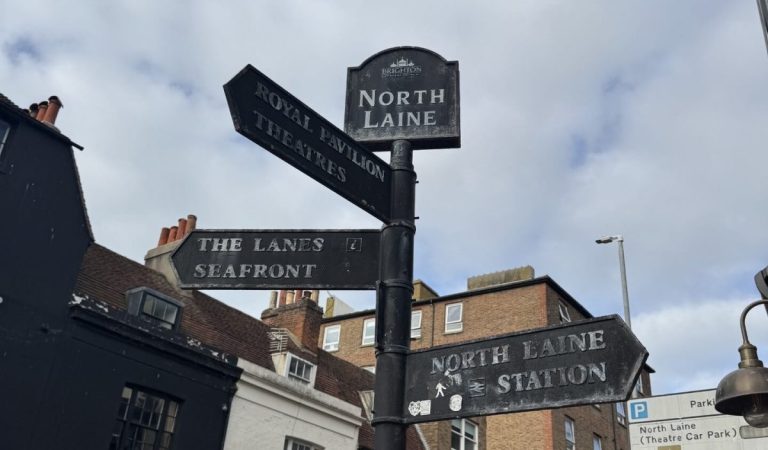
The landmark tourist attraction stands in the heart of Brighton, between North Laine, The Lanes, Old Steine and the seafront. Brighton Station is around 15 minutes away on foot, while Brighton Palace Pier and the beach are only a few minutes farther south.
The exterior is instantly recognisable, but the interior is where the Pavilion becomes genuinely extraordinary. Dragons appear on walls, chandeliers and furniture; lotus-shaped lights hang from elaborate ceilings; and extravagant rooms built for royal entertaining sit alongside displays explaining the building’s later use as a military hospital.
The Pavillion Gardens are free to walk through, and often used as a shortcut to the Theatre Royal.
Local tip
Visiting for the perfect Pavilion photo?
When I passed in late August 2026, scaffolding was visible on part of the Royal Pavilion. It does take some of the shine off those classic Instagram shots from the garden.
The position and extent of scaffolding can change as work progresses, so photographers making a special trip may want to check the latest view before travelling.
Royal Pavilion at a glance
| Address | Royal Pavilion, Brighton, BN1 1FN |
|---|---|
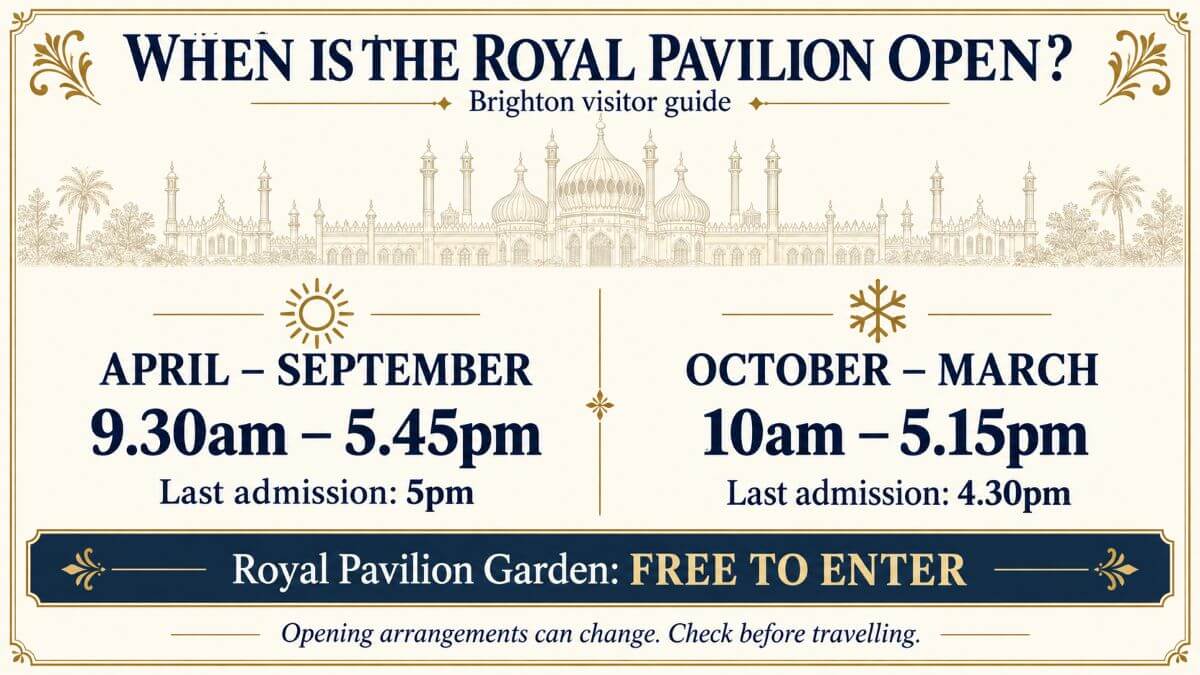
| April to September | 9.30am to 5.45pm; last admission 5pm |
| October to March | 10am to 5.15pm; last admission 4.30pm |
| Adult admission | £21.50 standard price |
| Children aged 5–18 | £13 standard price |
| Brighton & Hove residents | £16.50 for eligible BN1, BN2, BN3 and BN41 residents, including up to four accompanying children |
| Resident aged 13–18 | £9 |
| Eligible local students | £16.50 with proof of status |
| Online booking | 5% off standard adult, child and resident admission |
| Return visits | Standard admission operates as an annual pass for one year |
| Royal Pavilion Garden | Free to enter |
| Accessibility | Ground floor step-free; first floor reached by stairs only |
| Parking | No onsite parking |
| Café | Currently closed until further notice |
| Current Pavilion exhibition | DRAGONS, included with admission until 1 November 2026 |
Is the Royal Pavilion worth going inside?
Yes. The interior is what makes the Pavilion one of Brighton’s most unusual attractions.
Looking at the domes and minarets from the garden gives you the famous exterior, but it does not prepare you for the state rooms.
The Banqueting Room contains an enormous dragon chandelier, the Music Room is covered in red, gold and silvered decoration, and the Great Kitchen was equipped with some of the most advanced food-preparation technology available in the early 19th century.
The visit also tells a much broader story than George IV’s parties. The Pavilion became a civic building after Brighton bought it from the Crown and was later transformed into a military hospital during the First World War.
First visit
How long should you allow?
Allow around 90 minutes for a straightforward visit. Two hours is more comfortable if you want to use the audio guide, read the First World War displays properly and spend time looking at the decorative details.
What should you see inside the Royal Pavilion?
The principal state rooms are on the accessible ground floor, while the first floor contains royal bedrooms and the Indian Hospital Gallery.
| Must-see | Why stop? |
|---|---|
| Banqueting Room | Giant dragon chandelier and George IV’s spectacular royal dining room |
| Great Kitchen | One of the most technologically ambitious royal kitchens of its period |
| Saloon | Meticulously restored red, gold, blue and platinum 1823 decorative scheme |
| Music Room | Silvered dragons, lotus chandeliers, gilded dome and George IV’s musical world |
| Royal Bedrooms | A quieter look at the Pavilion as an actual residence rather than a stage for entertaining |
| Indian Hospital Gallery | Essential First World War history that changes how you understand the building |
The Banqueting Room
The Banqueting Room gives the fastest introduction to George IV’s taste.
Its central cut-glass chandelier measures about 9.1 metres from top to bottom and weighs almost a ton. Six silvered dragons appear to breathe fire through lotus-shaped lights beneath it.
The room was designed for spectacular royal dining. Tables were laid with elaborate silver, porcelain and decorations, while large dinners could involve dozens of dishes spread across several courses.
The decoration was created largely under designer Robert Jones and uses Chinoiserie: Chinese-inspired imagery produced for a European audience. It reflects Regency Britain’s fascination with imagined Asian decorative styles rather than an attempt to reproduce an authentic Chinese interior.
The Great Kitchen
The Great Kitchen is one of the easiest rooms to underestimate before visiting.
It was among the most technologically advanced kitchens of its day. Water was pumped from a nearby well, a large smoke jack could turn several roasting spits at once, and a steam table helped keep dishes warm before they reached the royal dining rooms.
Even the architecture was theatrical. Cast-iron columns are topped with painted copper palm leaves, turning a working kitchen into another part of the Pavilion’s spectacle.
George IV was sufficiently proud of the kitchen to show it to visitors.
He also employed celebrated French chef Marie-Antoine Carême in 1816. Carême became famous for elaborate dishes and architectural confectionery, supported at the Pavilion by specialist pastry and confectionery rooms.
The Saloon
The Saloon is one of the oldest surviving parts of the Pavilion and served as the formal reception room where George received guests before dinner.
Its present appearance is the result of a major conservation project reconstructing Robert Jones’s 1823 decorative scheme from surviving watercolours, bills, inventories and physical evidence.
The room combines red and gold textiles, a blue carpet, painted sky effects and reflective metallic decoration. Look for dragons, lotus leaves, sunflowers and the gilded snake eating its own tail, a traditional symbol of eternity.
The Music Room
The Music Room is another room where visitors need to look upwards.
Frederick Crace’s design combines rich red and gold decoration, silvered dragons, lotus-inspired chandeliers and a gilded domed ceiling.
George maintained a private band and sometimes sang, played piano or conducted. Italian composer Gioachino Rossini was entertained at the Pavilion in December 1823.
The room has also survived remarkable damage. A major fire affected it in 1975, and during the Great Storm of 1987 part of a minaret crashed through its recently restored ceiling.
George IV’s highly decorated 1821 piano is displayed in the adjoining Music Room Gallery.
The Royal Bedrooms
The bedrooms provide a useful contrast with the state rooms.
As George’s health deteriorated, his bedroom, bathroom and library were moved to the ground floor during Nash’s redevelopment, making his private apartments easier to use.
Upstairs, the Yellow Bow Rooms were used by George’s brothers.
Queen Victoria’s restored bedroom provides another insight into royal domestic life. Its four-poster bed contains six mattresses: two horsehair, two straw and two feather.
The Indian Hospital Gallery
The Indian Hospital Gallery explains one of the least expected chapters in the Pavilion’s history.
Photographs, paintings, film and contemporary accounts tell the story of the period when the royal state rooms were emptied of furniture and converted into hospital wards during the First World War.
The gallery is on the first floor. Visitors who cannot use the stairs can explore the wartime story through accessible audio and audiovisual material on the ground floor.
A different Pavilion
From pleasure palace to military hospital
More than 2,300 Indian soldiers were treated at the Royal Pavilion during the First World War. From 1916 it became a hospital for British servicemen who had lost limbs, treating more than 6,000 men before the military hospital finally closed in 1920.
Why does Brighton have a palace that looks like this?
The short answer is George IV.
George first visited Brighton as Prince of Wales in the 1780s, when the town was emerging as a fashionable seaside resort and sea bathing was promoted as beneficial to health.
He initially rented a lodging house before commissioning architect Henry Holland to transform the property into the Marine Pavilion.
By 1815, that building was no longer large or theatrical enough for the scale of royal entertaining George wanted. John Nash was asked to transform it into the extraordinary palace visible today.
Nash built around and over parts of the earlier structure, using cast iron to help support the domes, minarets and pinnacles.
The Pavilion combines different strands of Regency exoticism. The exterior uses British interpretations of Indian architectural forms, while much of the interior employs European Chinoiserie.
It is therefore best understood as a Regency British fantasy about Asian design rather than an authentic Indian or Chinese palace.
George IV’s pleasure palace
George became Prince Regent in 1811 and king in 1820.
The Pavilion was designed for dining, music, dancing and spectacle. Its interiors displayed royal wealth, collections and technological ambition while allowing George to entertain away from the formality of London.
Yet by the time the interior schemes were completed in 1823, his health was deteriorating.
George made only two further visits to Brighton, in 1824 and 1827, before his death in 1830.
William IV continued to use the Pavilion but in a less extravagant fashion.
Queen Victoria was much less enthusiastic. She disliked its association with George IV’s spending, found it too public and increasingly unsuitable for her growing family.
How the Royal Pavilion became Brighton’s palace
Queen Victoria sold the Royal Pavilion to the town of Brighton in 1850 for £53,000.
The purchase proved crucial to its survival. Demolition had been considered a realistic possibility, and Victoria ordered large quantities of furniture, fittings and decoration removed for use in other royal residences before the sale.
Brighton restored the principal ground-floor rooms and opened the former royal palace to the public.
Queen Victoria later returned chandeliers, wall paintings and other fittings in 1864, with additional royal gifts following later in the century.
The Pavilion has therefore been publicly owned for more than 175 years, a rare example of a former royal palace becoming a civic attraction rather than remaining within the Royal Household.
The Royal Pavilion as a First World War hospital
The Pavilion’s wartime history is as important as its royal story.
In late 1914, the Pavilion, Dome and Corn Exchange were converted into a military hospital complex. The Pavilion first treated soldiers of the Indian Army who had been wounded or become ill while fighting on the Western Front.
The transformation was rapid. Hundreds of beds were installed, plumbing was upgraded, X-ray equipment arrived and the Great Kitchen was converted into one of the operating theatres.
The first Indian patients arrived in December 1914. More than 2,300 Indian soldiers were treated before that phase of the hospital closed in January 1916.
Authorities took care to provide separate kitchens, places of worship and funeral arrangements appropriate to different religious and cultural requirements.
There was also a political dimension. The hospital was heavily publicised as evidence of the British Empire’s treatment of Indian troops, despite the Pavilion having been owned by Brighton rather than the Crown for more than 60 years.
In April 1916, the building reopened as a hospital for British servicemen who had undergone amputations.
More than 6,000 men were treated during that later phase. Rehabilitation went beyond fitting prosthetic limbs: patients were also trained in skills intended to help them find work after leaving military service.
The hospital finally closed in 1920.
The Indian Gate at the southern entrance to the estate was unveiled on 26 October 1921 in memory of the Pavilion’s wartime association with Indian soldiers.
What is happening at the Royal Pavilion in 2026?
DRAGONS
The Royal Pavilion is hosting DRAGONS until 1 November 2026.
The family exhibition takes the dragons already embedded throughout the Pavilion’s decoration and turns them into a trail through the palace.
Displays and activities explore how dragons have appeared in European and Asian cultures, while younger visitors can hunt for dragon imagery already woven into the rooms.
DRAGONS is included with ordinary Royal Pavilion admission.
Behind-the-scenes Pavilion tours
There are also opportunities to explore areas beyond the standard self-guided route.
Brighton & Hove Museums’ 2026 programme includes Basement & Tunnel Tours, which look at servant life and later wartime shelters, alongside Secrets of the Royal Pavilion tours covering the ground floor and Upper Chambers.
These are separate guided experiences with their own dates, capacity and booking arrangements, so check the Royal Pavilion’s current What’s On programme before travelling.
Royal Pavilion Garden restoration
The free garden surrounding the Pavilion is part of the historic design rather than simply a lawn around the palace.
John Nash conceived it as a Regency Picturesque landscape, using winding paths, irregular planting and carefully framed views to make a relatively compact garden appear larger and more natural.
Its appearance changed substantially during the Victorian era and the 20th century, while heavy modern use has created further pressure on paths, planting and historic features.
A major £6.4 million restoration project is now intended to restore more of Nash’s historic design, improve accessibility, renew paths and planting, protect wildlife habitats and add new interpretation, learning facilities, seating and a Changing Places toilet.
The National Lottery Heritage Fund is supporting the project with a grant of £4,369,755, alongside Brighton & Hove City Council, Brighton & Hove Museums and other funders.
The Grade II-listed garden is currently on Historic England’s Heritage at Risk Register, and one aim of the project is to secure its removal from that list.
Garden works
Major construction is currently planned for 2027
The present timetable places the main Royal Pavilion Garden capital works between January and December 2027, with handover, interpretation and project work continuing into 2028. The museum stresses that the dates are indicative and can change.
The garden is intended to remain a free public space, although individual sections may need to close while work is carried out.
Don’t miss Brighton & Hove Albion’s Stand or Fall gallery next door
Football supporters visiting the Pavilion in 2026 have another reason to go into Brighton Museum & Art Gallery, which stands on the same Royal Pavilion Estate.
Brighton & Hove Albion: Stand or Fall opened on 15 August 2026 as the club’s official gallery marking its 125th anniversary.
The exhibition is not inside the Royal Pavilion and requires admission to Brighton Museum rather than Pavilion admission.
It tells Albion’s story through memorabilia, archive material, film, supporter accounts and an elaborate stadium model linking the club’s different homes and defining moments.
Objects include an original 1908 shirt, material connected with the club’s 1910 Charity Shield victory and relics from the Goldstone Ground.
The gallery also gives considerable space to the supporter campaigns which helped save Albion during the club’s crisis years, including Fans United, protests, marches and the campaign for a new stadium at Falmer.
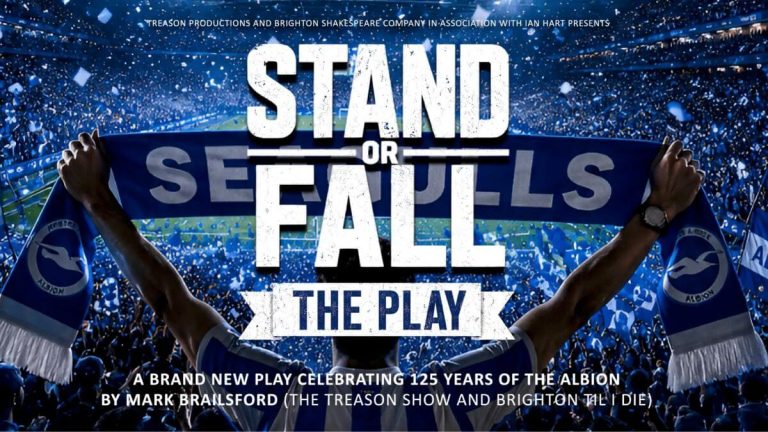
There is also a play of the same name at the Theatre Royal until 26th September 2026.
Albion fans
Stand or Fall is open at Brighton Museum
Brighton & Hove Albion: Stand or Fall is the club’s official new gallery at Brighton Museum & Art Gallery, next door to the Royal Pavilion. It opened in August 2026 as part of Albion’s 125th-anniversary celebrations.
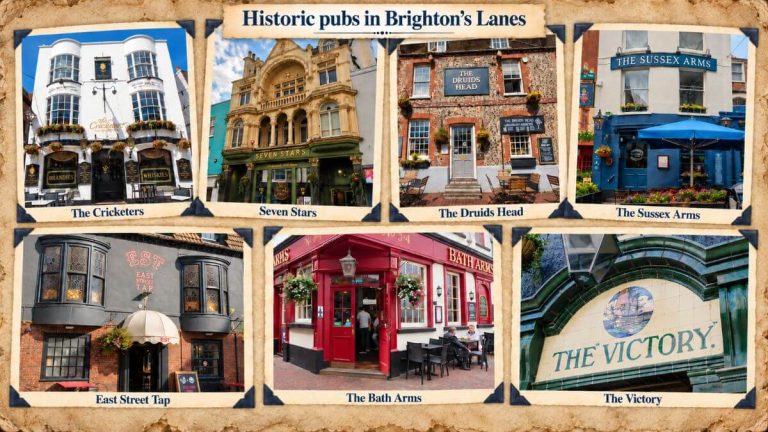
Albion supporters can continue the club’s story at Seven Stars, the historic pub where Brighton & Hove Albion began.
Brighton Museum currently charges £10.50 for adults and £5 for children aged five to 18, with separate resident and concession rates. Anyone planning to visit both attractions should check the current museum ticketing arrangements before travelling.
How much are Royal Pavilion tickets?
| Ticket | Current standard price |
|---|---|
| Adult | £21.50 |
| Child aged 5–18 | £13 |
| Eligible Brighton & Hove resident | £16.50, including up to four accompanying children |
| Resident aged 13–18 | £9 |
| Eligible local student | £16.50 with proof of status |
| Carer accompanying a disabled visitor | Free |
Standard adult, child and resident tickets currently receive a 5% discount when booked online.
The resident rate applies to qualifying BN1, BN2, BN3 and BN41 addresses, with proof required.
Families with at least one adult and two children currently receive one child ticket free.
Your Royal Pavilion ticket can be used for a year
Standard Pavilion admission operates as an annual pass, allowing repeat visits for one year from the date of issue.
Keep the ticket. Identification may be requested on later visits and should match the details associated with the pass.
That makes the headline admission price more useful for Brighton residents, regular visitors or anyone expecting to return for another exhibition.
A separate rail 2-for-1 offer is also available under specified conditions. Both visitors need qualifying dated rail tickets, and the offer cannot be combined with other discounts or concessions.
Royal Pavilion opening times
| Season | Opening hours | Last admission |
|---|---|---|
| April to September | 9.30am to 5.45pm | 5pm |
| October to March | 10am to 5.15pm | 4.30pm |
The Pavilion closes on 25 and 26 December and on 1 January, and closes early on 24 December.
Maintenance, special events and private functions can occasionally affect access, so check the official visitor page before making a special journey.
Accessibility at the Royal Pavilion
The ground floor is accessible to wheelchair users and contains many of the Pavilion’s most important rooms, including the Banqueting Room, Great Kitchen, Saloon, Music Room and King’s apartments.
The first floor can only be reached by stairs. Wheelchairs cannot be carried upstairs.
The audio guide includes video material covering the first floor for visitors who cannot use the staircase.
Accessibility
Most of the major state rooms are on the ground floor
The Banqueting Room, Great Kitchen, Saloon and Music Room are accessible without using the first-floor staircase. Visitors unable to go upstairs can use audiovisual material to explore the upper rooms and wartime displays.
Other facilities include an accessible toilet, manual wheelchairs and walkers on request, a hearing loop at the ticket desk, large-print material, seating and free admission for a companion or carer accompanying a disabled visitor.
Large mobility scooters generally need to be left at the entrance or at Brighton Museum, with visitors transferring to a manual wheelchair. Anyone with particular mobility requirements should contact the Pavilion before visiting.
How to get to the Royal Pavilion
Royal Pavilion
Brighton
BN1 1FN
From Brighton Station
The Pavilion is around a 15-minute walk from Brighton Station.
Leave the station down Queen’s Road towards the Clock Tower, take a left on Church Street or North Street and follow signs for the Royal Pavilion or Old Steine.
The route is downhill from the station and uphill on the return journey.
By bus
Numerous local bus services stop around Old Steine and North Street, leaving only a short walk to the Pavilion entrances.
From Brighton seafront
Brighton Palace Pier and the seafront are around five minutes away on foot via Old Steine.
By car
The Royal Pavilion has no onsite visitor parking.
Nearby city-centre options include The Lanes Car Park, the NCP on Church Street and Churchill Square’s car parks.
Blue Badge bays are available on nearby streets, subject to current council parking restrictions.
Food, photography and audio guides
The Royal Pavilion café is currently closed until further notice.
That is not a major obstacle given the location. New Road, North Laine, North Street, The Lanes and Old Steine all have cafés, pubs and restaurants within a few minutes’ walk.
Personal, non-commercial photography is normally allowed inside unless notices state otherwise. Flash, tripods and selfie sticks are not permitted.
Bags may be subject to security checks on arrival.
The Royal Pavilion audio guide is available on a handset or through a visitor’s own smartphone.
As well as the main palace tour, it includes a children’s version, First World War material and a DRAGONS tour during the exhibition period. Visitors using their own phone should bring headphones.
Before you go
Six useful Royal Pavilion tips
Book online: standard tickets are currently 5% cheaper online.
Keep your ticket: standard admission allows repeat visits for one year.
Allow around 90 minutes: longer if you want the audio guide and wartime displays.
Look upwards: many of the Pavilion’s best details are on ceilings, chandeliers and domes.
Do not skip the Great Kitchen: it is one of the clearest examples of the palace’s technological ambition.
Check What’s On: specialist tours and temporary exhibitions can add substantially to a visit.
Families comparing the Pavilion with other child-friendly attractions can also browse these things to do in Brighton and Hove with kids.
Around the Pavilion and beyond
- Explore more of Brighton and Hove for the rest of a city-centre day.
- Brighton and Hove’s BookBench Story Trail for the free autumn 2026 public-art trail.
Frequently asked questions
Is the Royal Pavilion worth going inside?
Yes. The exterior is famous, but the Banqueting Room, Music Room, Great Kitchen, Saloon and First World War history are what make the Pavilion genuinely distinctive. Allow around 90 minutes for a first visit.
How much does it cost to visit the Royal Pavilion?
Standard admission currently costs £21.50 for adults and £13 for children aged five to 18. Eligible Brighton & Hove residents pay £16.50, with up to four accompanying children included under the resident offer. Standard online bookings currently receive a 5% discount.
How long should you allow at the Royal Pavilion?
Around 90 minutes is sensible for a normal visit. Allow closer to two hours if you want to use the audio guide, inspect the rooms slowly and spend more time with the Indian Hospital Gallery and temporary exhibition.
Is the Royal Pavilion Garden free?
Yes. The Royal Pavilion Garden is a free public space. Admission is charged for the palace interior and Brighton Museum.
Can you return using the same Royal Pavilion ticket?
Yes. Standard Pavilion admission functions as an annual pass and permits repeat visits for one year, subject to the ticket conditions. Keep the ticket and bring matching identification for return visits.
Is the Royal Pavilion wheelchair accessible?
The ground floor is step-free and contains most of the principal state rooms. The first floor can only be reached by stairs, but audiovisual material is available for visitors unable to reach the upper rooms.
Why does the Royal Pavilion look Indian and Chinese?
The exterior uses Regency British interpretations of Indian architectural forms, while much of the interior uses European Chinoiserie. It is not an authentic Indian or Chinese palace but a British royal interpretation of Asian styles fashionable in the early 19th century.
Is the Stand or Fall Albion exhibition inside the Royal Pavilion?
No. Brighton & Hove Albion: Stand or Fall is in Brighton Museum & Art Gallery, immediately next to the Royal Pavilion on the same estate. It opened in August 2026 and requires Brighton Museum admission rather than a Royal Pavilion ticket.
A palace that became part of Brighton
The Royal Pavilion is often described simply as George IV’s fantasy palace, but that covers only one stage of its life.
It became a civic acquisition in 1850, a public attraction, a military hospital during the First World War and eventually the centrepiece of one of Brighton’s busiest historic public spaces.
Its decoration is excessive, theatrical and sometimes deliberately strange. That is precisely why it works.
The Pavilion was designed to make an impression. More than two centuries later, it still does.
Ticket prices, opening times, exhibitions, access information and restoration dates checked on 8 September 2026. Current Royal Pavilion and Brighton Museum information takes precedence where arrangements subsequently change.
You May Also Be Interested In