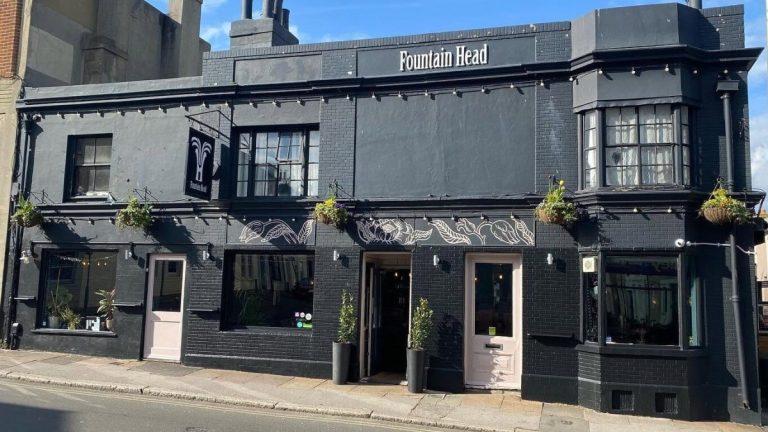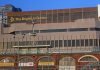













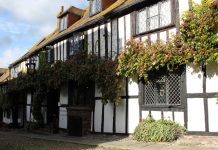

Brighton’s Lanes are known for jewellery shops, narrow twittens and restaurants, but the Old Town also contains some of the city’s richest pub history. From centuries-old drinking sites to Victorian tiled frontages and the pub where Brighton & Hove Albion began, these are seven historic stops worth knowing.
Within a compact part of central Brighton between North Street and the seafront are pubs associated with Tudor-era drinking traditions, Georgian houses, smugglers, Graham Greene and the formation of Brighton & Hove Albion.
These pubs are not just places for gathering to drink, although I have done that more than my fair share over the past decades. They are part of Brighton’s heritage and history. Compact landmarks where old walls, vintage frontage, regular patrons, local stories and the atmosphere of the Old Town still meet.
Some are classic pubs with food, beers and spirits; others feel more like modern bars built on historic drinking sites. Together, they show how Brighton’s pub culture has changed without completely losing its character.
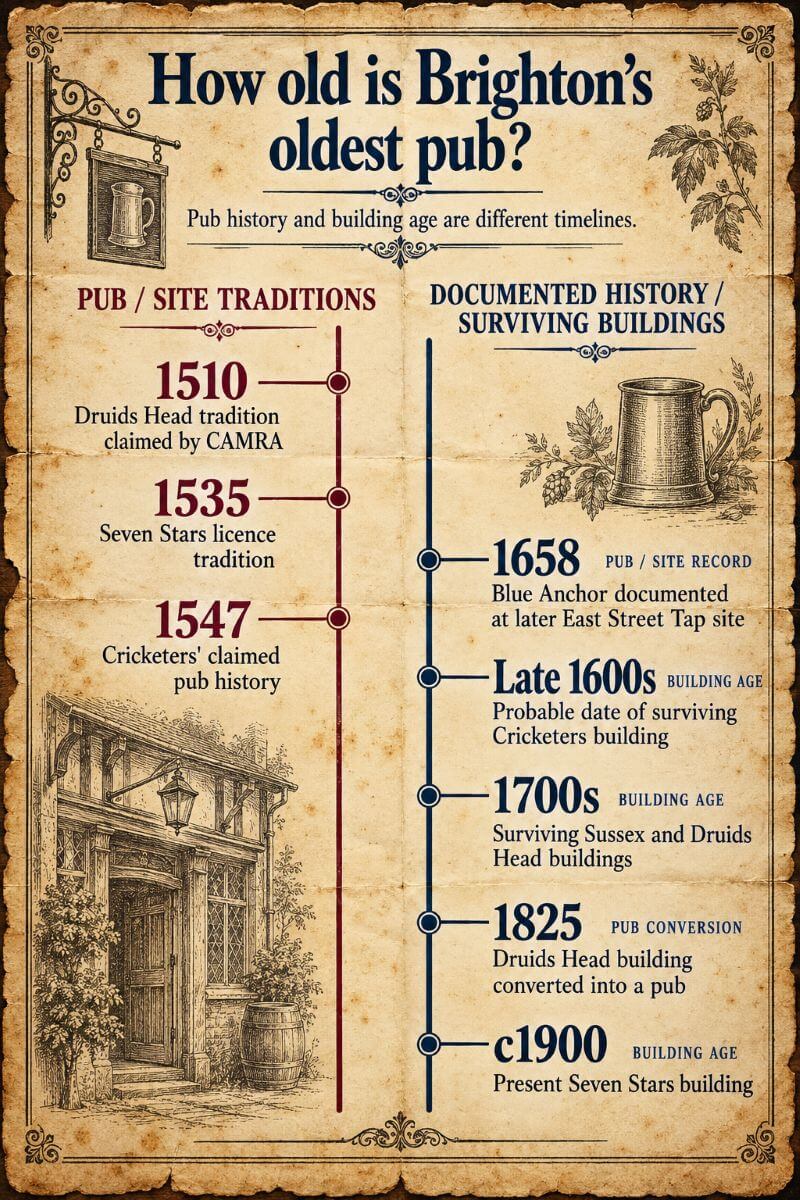
There is, however, a trap for anyone trying to identify Brighton’s oldest pub. A date displayed outside a pub may refer to a drinking site, a licence tradition, an earlier inn or a predecessor building rather than the structure standing there today.
Historic England’s listed-building records help separate those stories. The Cricketers, for example, traces its pub history to 1547, but Historic England dates the surviving building probably to the late 17th century. Seven Stars has a licence tradition dating to 1535 according to CAMRA, while its present listed building dates from around 1900.
Anyway, in the battle of Ye Oldest Pub, The Mermaid Inn in Rye is widely considered one of the oldest and most historic inns in Sussex, with cellars dating back to 1156. And that is an absolute cracker, and a shame Rye is so far east it’s practically Kent, as it is truly lovely there.
Pub history explained
What does “Brighton’s oldest pub” actually mean?
A very early date can refer to a drinking site, licence tradition or predecessor inn rather than the building standing there today. For this guide, we distinguish between the historic site, the surviving building and the current pub.
Historic pubs in Brighton’s Lanes at a glance
| Pub | Where | Why it matters |
|---|---|---|
| The Cricketers | 15 Black Lion Street | Claims a pub history from 1547; surviving building probably late 17th century; Grade II listed |
| The Druids Head | 9 Brighton Place | Late-18th-century house converted into a pub in 1825; Grade II listed |
| The Bath Arms | Meeting House Lane / Union Street | Early-19th-century house later remodelled as a pub; Grade II listed |
| Seven Stars | 27 Ship Street | Historic licence claim from 1535; Brighton & Hove Albion was formed here in 1901; Grade II listed |
| The Victory | Duke Street | Late-19th-century pub noted for its green glazed-tile frontage; Grade II listed |
| The Sussex | 33–34 East Street | 18th-century building formerly known as the Spread Eagle; Grade II listed |
| East Street Tap | 74 East Street | Venue claims a drinking history from at least 1568; an inn is documented on the site by 1658 |
Why The Lanes have so many historic pubs
The Lanes occupy part of Brighton’s Old Town and are not to be confused with the Laine, the historic core of the fishing settlement that developed into modern Brighton.
Brighton & Hove City Council’s Old Town Conservation Area was designated in 1973 and extended in 1977. The historic area includes streets between North Street and the seafront, with East Street and West Street marking its eastern and western sides.
Its surviving lanes and twittens are remnants of a much older street pattern. Ship Street, East Street and Middle Street were important routes long before Brighton became the fashionable seaside resort associated with the Prince Regent and Royal Pavilion.
The related guide explains how the Sussex word “twitten” describes these narrow passages and connects the term with walks in other parts of the county.
Fishermen, traders, travellers and later generations of visitors all needed places to drink, eat and stay. Inns, taverns and alehouses consequently became part of the Old Town landscape.
What survives today is a mixture. Some pubs occupy genuinely old buildings, some stand on much older drinking sites, while others preserve Victorian and Edwardian pub architecture rather than Tudor or Georgian fabric.
Interestingly though, none of the pubs are independently owned, but perhaps that is a key part in retaining the character of each.
Which is Brighton’s oldest pub?
There is no completely straightforward answer.
The Cricketers describes itself as Brighton’s oldest pub and dates its history to 1547. Historic England provides an important qualification that although its exterior carries the date 1886, the surviving building probably dates from the late 17th century, with additions made in 1790 and 1824.
Seven Stars has an even earlier traditional claim. Brighton & South Downs CAMRA records the Ship Street pub as licensed since 1535, but Historic England dates the present Grade II-listed building to around 1900.
The Druids Head provides another good example of why the dates need care. CAMRA describes it as a historic pub dating to 1510, but Historic England identifies the surviving building as a late-18th-century house converted into a public house in early 1825. Local street research says it initially traded as the Myrtle Tree before taking the Druids Head name in 1836.
East Street Tap makes its own claim to date from at least 1568. Local historical research provides firmer evidence of an inn at 74 East Street by 1658, when the site was associated with the Blue Anchor.
The useful answer, therefore, is not to declare one unquestioned winner. The Lanes contain several exceptionally old drinking traditions, but their surviving buildings belong to different periods. And we are all winners, as they are fantastic pubs to drink in.
1. The Cricketers, Black Lion Street
The Cricketers is probably the pub most visitors will encounter when searching for Brighton’s oldest.
The pub itself traces its history to 1547, but the architectural evidence tells a more complicated story.
Historic England’s Grade II listing for The Cricketers says the building probably dates from the late 17th century. It records an addition in 1790, when it was renamed The Cricketers, followed by further work in 1824. The exterior dates from 1886.
That gives visitors several periods of Brighton history in one building rather than a preserved Tudor pub frozen in time.
The Cricketers also has a literary association with Graham Greene’s Brighton Rock. The upstairs Greene Room continues that connection, while the pub’s Victorian-style interior helps distinguish it from some of the more contemporary bars around the Old Town.
Look closely
1547 does not mean the frontage is Tudor
The Cricketers traces its pub history to 1547, but Historic England says the surviving building is probably late 17th century. Its exterior is dated 1886, making the pub a particularly good example of how Brighton’s drinking sites evolved over centuries.
2. The Druids Head, Brighton Place
The Druids Head looks suitably ancient among the narrow streets of The Lanes, but its documented building history is more useful than some of the legends attached to it.
Historic England dates the Grade II-listed building to the late 18th century. It began as a house and was converted into a public house in early 1825.
The building retains flintwork, painted brick detailing and a tiled roof, giving it a noticeably different character from the grander Victorian and Edwardian pub frontages elsewhere in central Brighton.
There is also some substance behind the local stories of passages beneath the building, although this is where folklore can quickly outrun the evidence. Historic England records a reported blocked cellar passage but adds that such passages were common in this part of the Old Town.
Local historical research says the converted pub was initially called the Myrtle Tree in 1825 and took the Druids Head name in 1836.
That is a much more interesting story than simply attaching a very early date to the modern pub, it’s an 18th-century Brighton house became a pub as the town expanded rapidly during the Georgian period.
3. The Bath Arms, Meeting House Lane
The Bath Arms sits in the part of The Lanes that most closely matches the visitor image of old Brighton with narrow pedestrian routes, jewellery shops and buildings packed tightly around Meeting House Lane.
Historic England lists the Bath Arms at 4 and 5 Meeting House Lane and 6 Union Street.
The Grade II-listed building began as an early-19th-century house and was remodelled as a public house in the late 19th or early 20th century.
That makes it different from The Cricketers. Its significance is not based on a Tudor-era licence claim, but on the survival and adaptation of an old building within the historic street pattern.
Its corner position also makes the Bath Arms a useful stopping point on a walking route through Brighton Square, Meeting House Lane and the surrounding twittens.
4. Seven Stars, Ship Street
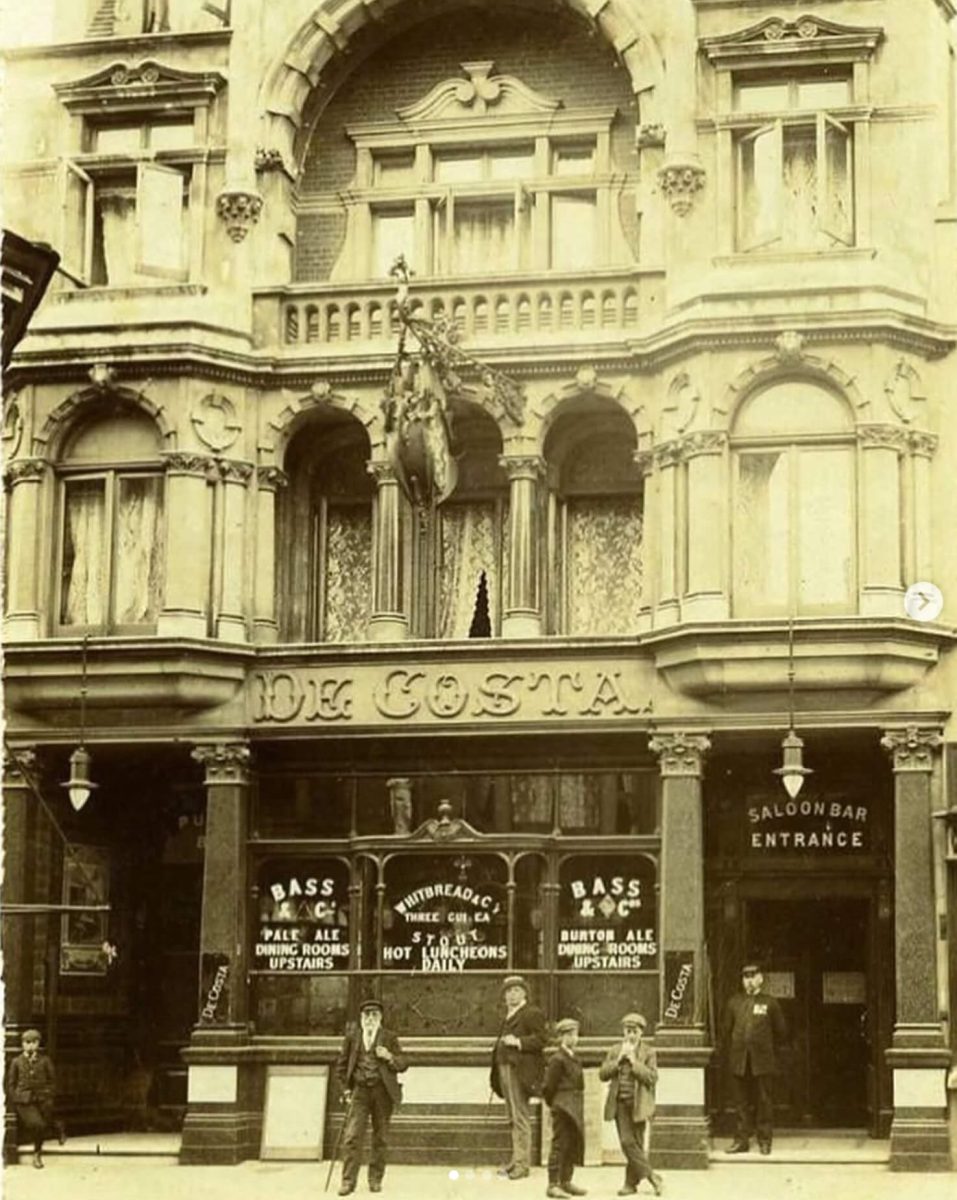
Seven Stars has arguably the most important connection with Brighton’s sporting history.
Brighton & Hove Albion traces its formation to a meeting at the Seven Stars on 24 June 1901.
The connection was formally marked again on 24 June 2026, when Albion celebrated its 125th anniversary by unveiling an official blue plaque at the pub. The club also paid tribute to founder and first manager John Jackson.
The pub’s history extends beyond football. Brighton & South Downs CAMRA records Seven Stars as licensed since 1535, making it one of the earliest pub-site claims in the city.
But once again, the building is considerably younger. Historic England dates the present Seven Stars to around 1900.
Albion history
The pub where Brighton & Hove Albion began
Seven Stars, 27 Ship Street
Albion traces its formation to a meeting here on 24 June 1901. An official blue plaque marking the connection was unveiled for the club’s 125th anniversary in June 2026.
The combination makes Seven Stars particularly interesting. It has one of Brighton’s oldest licence traditions, a Grade II-listed building and a direct connection with an institution that remains central to the identity of the city.
5. The Victory, Duke Street
The Victory is younger than Brighton’s Tudor and Georgian pub-site traditions, but it earns its place because of what survives above and around the bar.
Historic England describes The Victory as a late-19th-century public house, probably converted from an earlier building and altered around 1910.
Its most obvious feature is at street level. The ground-floor frontage is faced in light and dark green glazed tiles, a striking survivor from the era when breweries and pub owners used elaborate ceramics, etched glass and architectural detailing to make their premises stand out.
In a district where attention naturally gravitates towards claims of 16th-century origins, The Victory is a reminder that Victorian and Edwardian pub architecture is historic in its own right.
6. The Sussex, East Street
The Sussex occupies an important position on East Street, close to the route between the Old Town and seafront.
Historic England dates the Grade II-listed building to the 18th century, with an extension in the early 19th century.
The pub was formerly known as The Spread Eagle. Historic England records that name and says the pub retained it until 1816.
The official listing also notes a tradition that the premises were used by smugglers. That is worth reporting as part of the building’s history, but it is better treated as recorded tradition than proof of the elaborate tunnel networks sometimes attributed to Brighton’s old pubs.
The building itself is the stronger story, an 18th-century house adapted and extended as East Street became part of a rapidly changing seaside town.
7. East Street Tap, East Street
East Street Tap demonstrates particularly clearly how an ancient pub site can support a very modern bar.
The venue describes itself as Brighton’s oldest boozer and dates its history to at least 1568.
Local historical research provides documentary evidence of a pub site by 1658, when an inn at 74 East Street was known as the Blue Anchor.
It subsequently passed through several identities, including the Greyhound and Fish Bowl, before becoming East Street Tap.
The present venue is deliberately contemporary, with craft beer, DJs, live music and late opening. Yet it occupies a site associated with drinking for well over three centuries.
That contrast is useful when exploring The Lanes. Historic pubs do not all need horse brasses, low ceilings and dark timber to have a genuine connection with Brighton’s past.
What about the Black Lion and King & Queen?
I hear you ask, maybe. Any list of seven historic Brighton pubs is going to leave out places with substantial stories of their own. Brighton is full of old pubs worthy of making the list.
The Black Lion, Black Lion Street
The Black Lion has a brewing tradition dating to around 1546, making its site one of the most historically interesting in Brighton’s Old Town.
Local historical research associates the Black Lion brewery with Deryk Carver, a Flemish-born brewer and Protestant who was executed for heresy at Lewes in 1555.
There is, however, an important catch for anyone admiring what appears to be a remarkably well-preserved Tudor building. The Black Lion standing today dates from 1974.
The old brewery had fallen out of use by 1968 and was demolished. The present pub was subsequently constructed as a reconstruction of part of the historic brewery, using original materials including flints and slates.
That makes the Black Lion a particularly good example for this guide. The site has a history stretching back to the 16th century, but the building visitors see today is a 20th-century reconstruction.
But of course, it is directly next to The Cricketers, so you will see it on the route.
The King & Queen, Marlborough Place
The King & Queen can trace its licensed pub history to 1779, although it sits just outside the Old Town boundary covered by our main Lanes walk.
The original inn developed from a farmhouse on what was then the edge of Brighton. It was licensed in 1779 and became closely associated with sporting events taking place on the nearby open land.
The King & Queen also had an important commercial role. Brighton’s corn market operated there until 1868, when it moved to the Corn Exchange in Church Street.
Again, the building itself is younger than the pub tradition. The original Georgian inn was replaced by the extraordinary mock-Tudor building standing today in 1931–32.
Designed by Brighton architects Clayton & Black, the present King & Queen is Grade II listed. Its half-timbering, brickwork, large hall and deliberately theatrical medieval appearance make it look much older than it really is.
So while it falls just outside our seven-pub Lanes route, it deserves a mention. It was licensed since 1779, rebuilt in 1931–32 and still one of central Brighton’s most recognisable pubs. It was always a very good venue for watching football too.
The Brighton Lanes historic pubs walk/crawl
One advantage of exploring pub history in The Lanes is that virtually everything is within a compact part of the Old Town. The seven main stops can comfortably be connected on foot, with the streets and buildings between them forming part of the experience.
If I were doing the route, I’d start and finish around East Street. The Sussex is close to the taxi rank and North Street bus stops, making this side of the Old Town a convenient place to finish if the historical research somehow turns into an evening in the pub.
Technically though, I’d start with The Fiddler’s Elbow on Boyce’s Street which dates back to at least 1852.
I’ve drunk in all seven listed but haven’t eaten in enough of them to pretend this is a food review. If you’re planning lunch or dinner around the route, check the pub’s current menu, service times and recent customer reviews before choosing your stop.
| Stop | Pub | Street | What to look for |
|---|---|---|---|
| 1 | The Victory | Duke Street | Green glazed Victorian and Edwardian frontage |
| 2 | Seven Stars | Ship Street | Albion’s 125th-anniversary blue plaque |
| 3 | The Cricketers | Black Lion Street | 1886 exterior concealing a considerably older building |
| 4 | The Bath Arms | Meeting House Lane | Historic corner building among the central lanes |
| 5 | The Druids Head | Brighton Place | Flintwork and the scale of an 18th-century Old Town house |
| 6 | The Sussex | East Street | 18th-century building and its former Spread Eagle identity |
| 7 | East Street Tap | East Street | A modern pub on a drinking site documented by the 17th century |
The entire route is compact, but there is no reason to rush it. Anyone following the walk primarily for its history should remember to look above the modern shopfronts and pub signs. Upper storeys often reveal considerably more about the age and development of a building than what is happening at pavement level.
A better way to explore
A history walk rather than a seven-pint challenge
All seven pubs can be connected on foot through Brighton’s compact Old Town. There is no need to drink alcohol at every stop, the listed buildings, old street pattern, historic frontages and Albion connection make the route worthwhile in their own right.
What to look for beyond the bar
Part of the pleasure of exploring Brighton’s historic pubs is looking beyond the bar. Flintwork, glazed tiles, old windows, upper storeys, pub signs and historic frontages can tell you far more about a building’s history than its present-day furniture.
At The Cricketers, the important detail is the contrast between the age of the underlying building and its later appearance. Historic England dates the surviving structure probably to the late 17th century, but records additions in 1790 and 1824 and an exterior dated 1886. It is a building that has evolved with Brighton rather than surviving unchanged from one period.
The Druids Head gives a different impression. Its flintwork, tiled roof and relatively modest scale reflect its origins as a late-18th-century house before conversion into a pub in 1825.
At The Victory, look particularly at the light and dark green glazed tiles around the ground floor. They are a reminder that Victorian and Edwardian pub design could be deliberately decorative and eye-catching.
Seven Stars is worth examining for another reason. The present building dates from around 1900, placing it remarkably close to the 1901 meeting associated with the formation of Brighton & Hove Albion. The blue plaque unveiled in 2026 now makes that connection visible from the street.
East Street, meanwhile, shows how Brighton’s Old Town opens towards the seafront. The Sussex occupies an 18th-century building on a street that was important long before the Victorian resort expanded around it, while East Street Tap demonstrates how a historic drinking site can continue through repeated changes of name and character.
Planning a visit to Brighton’s historic pubs
The pubs are concentrated within Brighton’s Old Town and are straightforward to reach on foot from Brighton Station, the Royal Pavilion and the seafront.
From Brighton Station, allow roughly 10 to 15 minutes to reach the northern side of The Lanes at a normal walking pace. Brighton Palace Pier and the beach are only a few minutes beyond East Street, making the route easy to combine with a wider visit to central Brighton.
Opening hours, kitchen times, private events and age policies vary between venues. Anyone making a special journey for a particular pub should check the pub’s own current information before travelling.
Several of the pubs occupy listed historic buildings. Narrow entrances, changes in floor level, stairs and older toilets can create access limitations that would not necessarily exist in a modern purpose-built venue.
Accessibility
Historic buildings can have access limitations
Step-free access, accessible toilets and access to upstairs rooms vary between the pubs. If you have a specific access requirement, check directly with the venue before travelling rather than assuming every part of a listed building is accessible.
Frequently asked questions
What is the oldest pub in Brighton?
There is no completely uncontested answer because different claims refer to different things. The Cricketers dates its pub history to 1547, Seven Stars has a licence tradition said to date to 1535, and East Street Tap claims a drinking history from at least 1568. Their surviving buildings are of different ages, with Historic England dating The Cricketers probably to the late 17th century and the present Seven Stars to around 1900.
Is The Cricketers building really from 1547?
No, not according to the listed-building evidence. The pub traces its history to 1547, but Historic England says the surviving building probably dates from the late 17th century. It was subsequently altered, and its present exterior is dated 1886.
Which Brighton pub was Brighton & Hove Albion founded in?
Brighton & Hove Albion traces its formation to a meeting at Seven Stars in Ship Street on 24 June 1901. The club marked the connection by unveiling an official blue plaque at the pub on its 125th anniversary in June 2026.
Which historic pubs in The Lanes are listed buildings?
The Cricketers, Druids Head, Bath Arms, Seven Stars, Victory and Sussex are Grade II listed by Historic England. East Street Tap is included because of the much older documented drinking history of its East Street site rather than because its current building has the same listed status.
Are there tunnels under Brighton’s old pubs?
There is evidence for cellar passages beneath parts of the Old Town, but the subject has accumulated a considerable amount of folklore. Historic England’s listing for the Druids Head records a reported blocked cellar passage and notes that such passages were common locally. Claims about extensive secret networks linking multiple pubs should be treated cautiously unless evidence exists for a particular route.
Can you walk between all seven pubs?
Yes. The pubs are concentrated in and around Brighton’s compact Old Town. Duke Street, Ship Street, Black Lion Street, Meeting House Lane, Brighton Place and East Street can all be connected without a long walk.
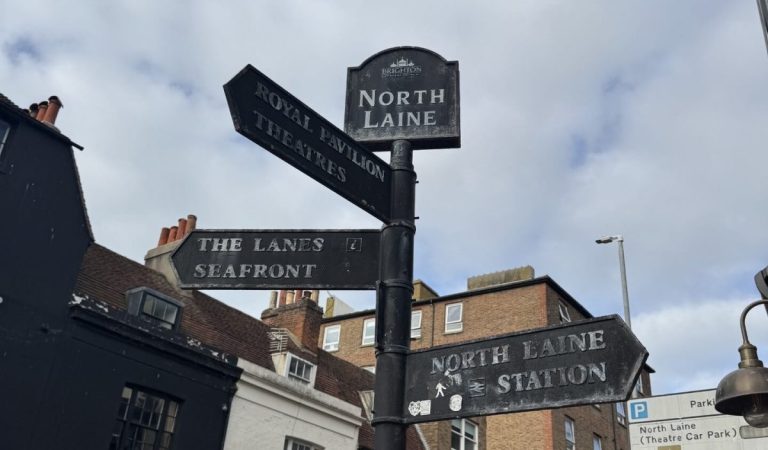
Are Brighton’s Lanes the same as North Laine?
No. The Lanes form part of Brighton’s historic Old Town south of North Street towards the seafront. North Laine is the separate district north of North Street towards Brighton Station. Despite the similar names, the two areas have different histories and street patterns.
Sources and further reading
The architectural dates in this guide have been checked primarily against Historic England’s statutory listed-building records, with individual pub histories and Brighton & Hove Albion used for venue-specific claims and the Seven Stars football connection.
- Historic England: The Cricketers
- Historic England: The Druids Head
- Historic England: The Bath Arms
- Historic England: Seven Stars
- Historic England: The Victory
- Historic England: The Sussex
- The Cricketers: pub history
- East Street Tap
- Brighton & Hove Albion: Seven Stars blue plaque
Very early dates associated with historic pubs may describe a drinking site or licence tradition rather than the age of the surviving building.
You May Also Be Interested In