



















The Seven Sisters are among the most recognisable landscapes on the Sussex coast, but seeing them at their best takes a little planning. Here is how to reach the cliffs from Brighton, London, Seaford and Eastbourne, where to find the classic view and how to walk the area safely.
The white chalk cliffs of the Seven Sisters rise and fall along the Sussex Heritage Coast between the Cuckmere Valley and Birling Gap, forming one of the best-known sections of the South Downs National Park.
The landscape is spectacular but also dynamic. Chalk is continually eroded by the sea and weather, and cliff falls can happen without warning. A good visit therefore combines the views with sensible route planning rather than trying to get as close to the edge as possible.
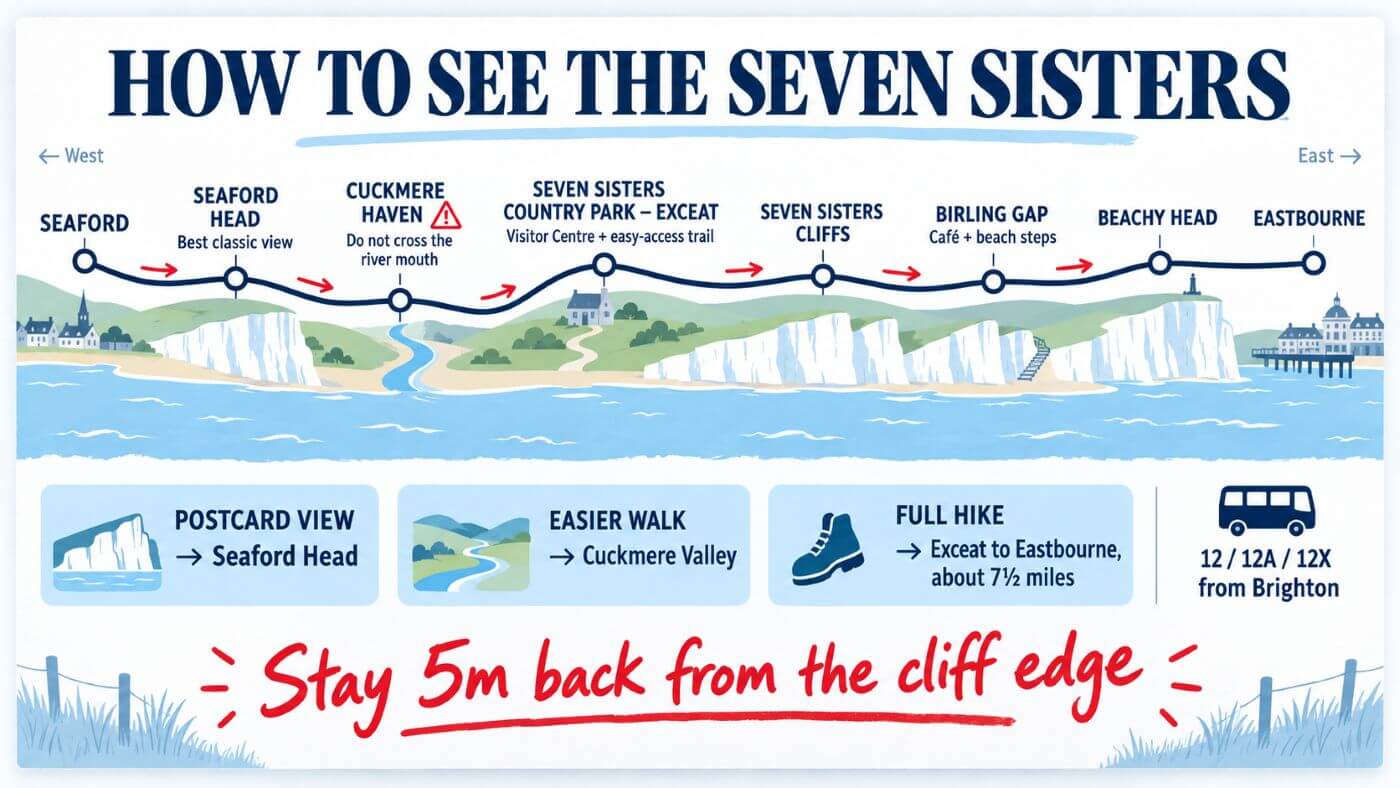
| Where | East Sussex coast between Seaford and Eastbourne |
| Main visitor base | Seven Sisters Country Park at Exceat, near Seaford, BN25 4AD |
| Best-known viewpoint | Seaford Head, looking across Cuckmere Haven towards the Seven Sisters |
| Best public transport | Coaster 12, 12A and 12X buses between Brighton, Seaford and Eastbourne |
| Classic long walk | Seven Sisters Country Park to Eastbourne via Birling Gap and Beachy Head |
| Easy-access option | Cuckmere Valley trail from Seven Sisters Country Park towards the beach, around 4km return |
| Cliff safety | Stay at least 5 metres from the cliff edge and the base of the cliffs |
| Important warning | Do not attempt to cross the River Cuckmere at the river mouth |
Where exactly are the Seven Sisters?
The Seven Sisters form part of the chalk coastline between Cuckmere Haven and Birling Gap, west of Beachy Head and Eastbourne.
The wider visitor landscape includes Seven Sisters Country Park at Exceat, the meandering Cuckmere River and Cuckmere Haven to the west, the rolling cliff tops themselves, and Birling Gap towards the eastern end.
Seven Sisters Country Park lies within the South Downs National Park and is now part of the wider Seven Sisters National Nature Reserve, which protects chalk grassland, saltmarsh, woodland, floodplain and marine habitats.
The cliffs are not static. Seven Sisters Country Park estimates that around 30cm to 40cm of the coastal edge is lost to erosion in an average year, while erosion around Birling Gap can locally be considerably faster.
Where is the best view of the Seven Sisters?
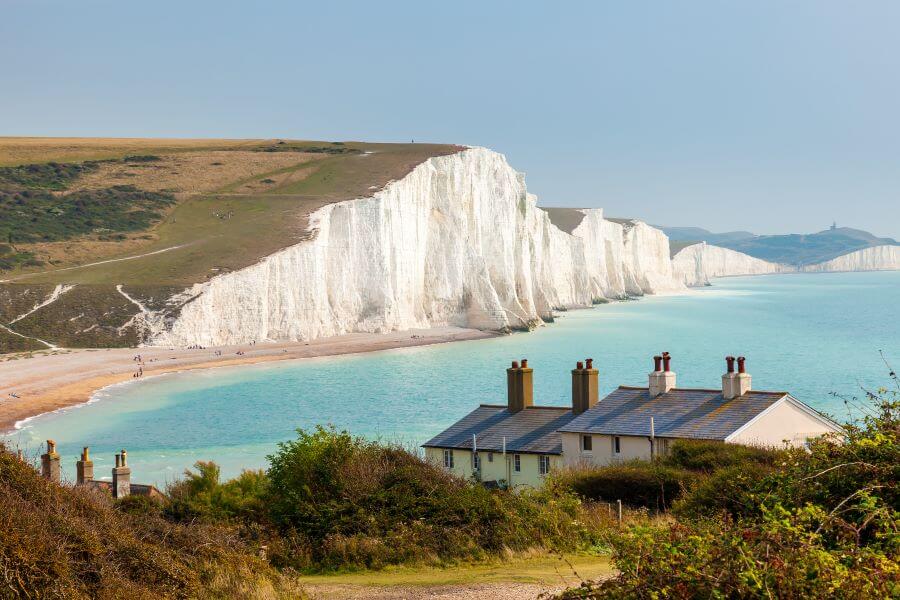
For the classic photograph showing the white cliffs unfolding one behind another beyond the coastguard cottages, Seaford Head is the strongest viewpoint (see main image). There is a small car park there, and it’s a short walk downhill to get to the end.
Sussex Wildlife Trust, which helps manage Seaford Head Local Nature Reserve, describes it as the best place to enjoy the iconic view of the Seven Sisters and Cuckmere Valley.
A particularly useful option is to approach from South Hill Barn above Seaford. From there, paths lead towards viewpoints across Cuckmere Haven.
From Seaford Head it is possible to continue on foot through the reserve towards Hope Gap and Cuckmere Haven. What you cannot do safely is simply cross the river mouth to reach Seven Sisters Country Park on the other side.
Local tip
For the postcard view, start in Seaford
If your main aim is the famous photograph of the coastguard cottages with the cliffs behind them, start from Seaford Head or South Hill Barn rather than Seven Sisters Country Park. The Country Park gives you the Cuckmere Valley and access towards the cliffs, but the classic view is from the opposite side of the river.
Safety
Do not cross the River Cuckmere for the photograph
The river mouth is not a safe shortcut between Seven Sisters Country Park and Seaford Head. At high tide the water can be six to seven metres deep and carries a strong current. Follow the designated walking route around the estuary instead.
How to get to the Seven Sisters from Brighton
The simplest public-transport route from Brighton is the Coaster 12, 12A or 12X bus towards Eastbourne.
Seven Sisters Country Park says all three services stop at the park entrance at Exceat and connect with railway stations at Brighton, Seaford and Eastbourne.
The journey is also part of the experience. The coastal bus route passes through countryside towns and villages east of Brighton before reaching the Cuckmere Valley, and an upstairs seat can provide the beauty of wide views of the South Downs and coast.
For the classic Seaford Head viewpoint rather than the Country Park, another option is to travel to Seaford and begin there. The South Downs National Park’s Seaford Head route can be reached from South Hill Barn, while bus passengers can use the Chyngton Lane stop and walk towards the reserve.
How to visit from London
Visitors coming from London have several sensible rail-and-bus combinations rather than needing to travel through Brighton in every case.
You can take a train to Brighton and continue east on the Coaster bus, or travel by rail towards Seaford or Eastbourne and connect from there.
Southern Railway specifically promotes the coast as suitable for a car-free journey, including itineraries where walkers travel out towards Seaford and return from Eastbourne after crossing the Seven Sisters.
For anyone planning on hiking the full cliff-top walk, travelling into one town and home from another can be considerably easier than trying to return to a parked car at the starting point.
Can you drive to the Seven Sisters?
Yes. Seven Sisters Country Park is on the A259 at Exceat, between Seaford and Eastbourne.
The Country Park has parking, although spaces can be in heavy demand during sunny weekends, bank holidays and school holidays. The car parks operate during published daytime hours and are locked overnight.
Birling Gap also has a National Trust car park and provides another useful starting point for shorter coastal walks.
If you are driving from farther away, check live road conditions before setting out rather than relying on assumptions about the M25 or other routes around London.
Driving tip
Allow extra time at Exceat Bridge
The A259 crosses the Cuckmere beside the Cuckmere Inn (formerly the Golden Galleon) on a single-lane bridge controlled by traffic lights. It is a notorious pinch point and queues can become substantial on sunny weekends and busy holiday days.
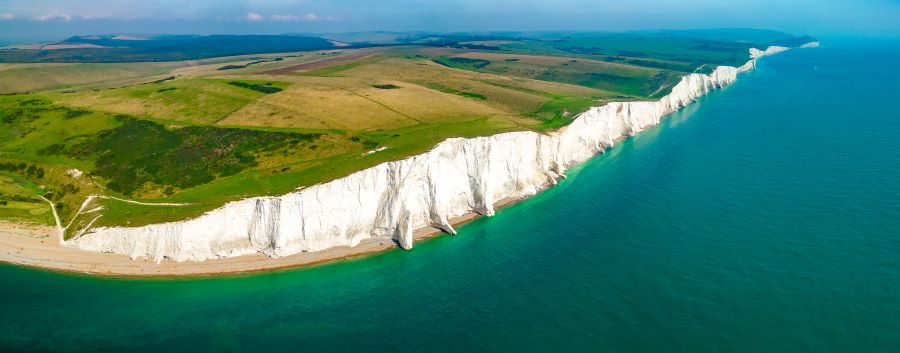
The best Seven Sisters walks
There is no single Seven Sisters walk. The right route depends on whether you want the famous photograph, a gentler valley route or a demanding day across the cliff tops.
Seven Sisters Country Park to Cuckmere Haven
For a relatively gentle introduction, follow the valley floor from the visitor centre towards the shingle beach and mouth of the River Cuckmere.
The South Downs National Park describes its Easy Access Trail as suitable for people with impaired mobility, wheelchairs, mobility scooters and pushchairs. And I can confirm this as I’ve used pushchairs, and my last visit we took bikes and it’s a lovely wide path.
The route is about 2km each way, around 4km return. There is a short steeper incline of more than 1:8 towards the shingle at the end.
It gives good views of the Cuckmere Valley and Seaford Head without requiring the steep climbs of the cliff-top route and is a beautiful walk when it’s not busy, which is sadly rare these days.
Seaford Head for the classic view
If photography is the priority, Seaford Head is hard to beat.
The South Downs National Park publishes an easy-access trail from South Hill Barn offering views over Cuckmere Haven, the coastguard cottages and the Seven Sisters. The route is around one to two miles and is intended for a broader range of mobility levels than the full coastal hike.
Sussex Wildlife Trust currently warns of significant cracking and recent cliff falls around parts of Seaford Head, so visitors should follow diversions and remain well away from the cliff edge.
Seven Sisters to Eastbourne
For experienced walkers, the cliff-top route towards Birling Gap, Belle Tout, Beachy Head and Eastbourne is one of the great South Downs coastal walks.
The South Downs National Park gives its Seven Sisters-to-Eastbourne route as around 7½ miles, taking approximately three to four hours.
The route involves repeated climbs and descents, so the official timing should be treated as a guide rather than a deadline. Photography stops, food, wind and wet ground can all add considerably to the journey.
Belle Tout is the former cliff-top lighthouse, while the red-and-white Beachy Head lighthouse remains in operation below the cliffs.
The advantage of public transport is that walkers can start near Seven Sisters Country Park and finish in Eastbourne without having to retrace the entire route.
How dangerous are the Seven Sisters cliffs?
The cliffs are beautiful, but they need to be treated as unstable natural structures rather than viewing platforms.
Seven Sisters Country Park and the National Trust both warn that chalk falls can occur at any time and without warning. Cracks and overhangs are not always visible from above.
Please do not go close to the edge for a photograph. Cliff collapses are part of the natural erosion of this coast, while the sea below can also be powerful and unpredictable.
Cliff safety
Stay at least five metres back
Keep at least five metres from the cliff edge and at least five metres from the base of the cliffs. Stay on marked routes, obey temporary diversions, check the weather and tides, keep dogs under close control and never attempt to cross the River Cuckmere at its mouth. In a coastal emergency call 999 or 112 and ask for the Coastguard.
The danger is not limited to standing directly on the visible edge. Chalk can fracture behind it, while people on the beach can be injured by falling material from above.
The safest photographs are therefore taken well back from the edge rather than with feet hanging over it.
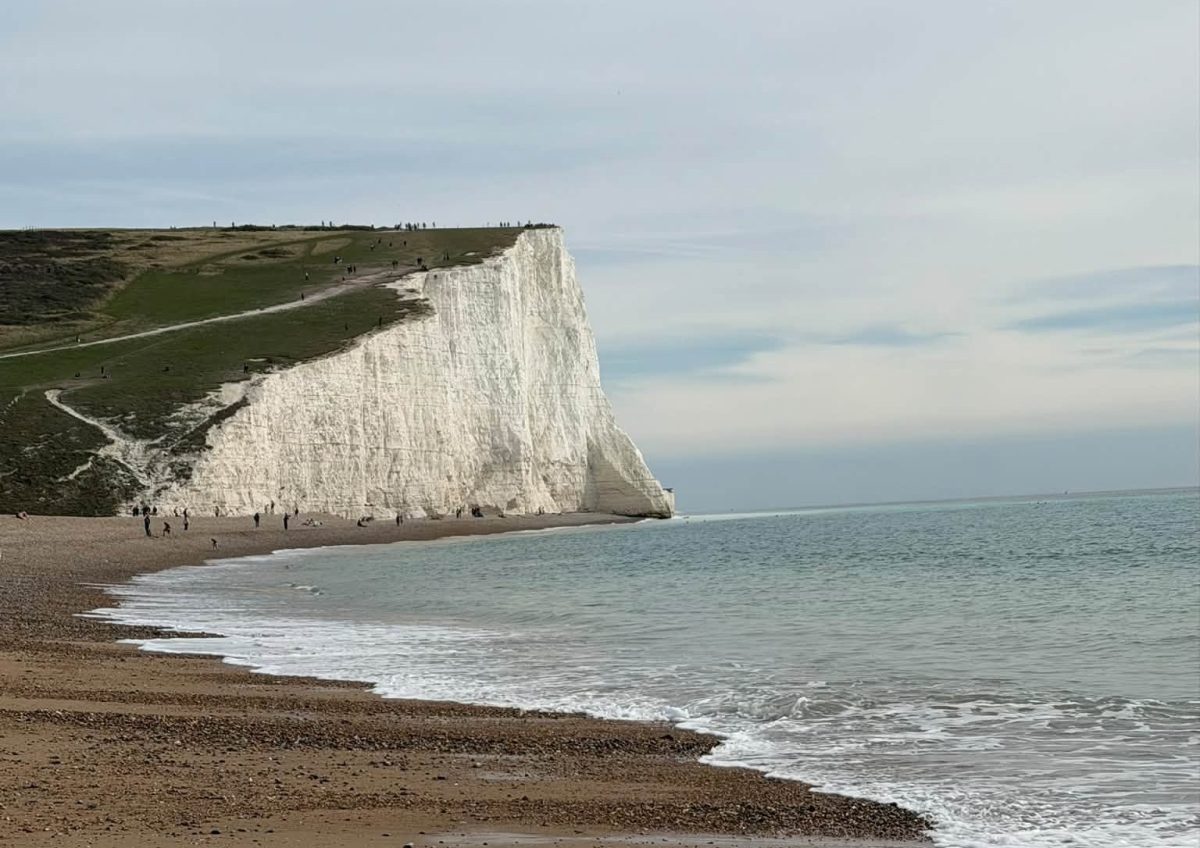
Can you walk along the beach beneath the Seven Sisters?
Beach access is possible at places including Birling Gap, but walking beneath the cliffs requires particular caution.
The National Trust warns visitors to stay well away from the base because rock falls can happen without warning. Incoming tides can also cut people off and force them towards the unstable cliff face.
At Birling Gap, the National Trust advises visitors not to walk more than around 150 metres either side of the beach access platform and to keep the steps in sight.
The beach should therefore not be treated as an alternative through-route beneath the Seven Sisters.
What is Birling Gap?
Birling Gap sits towards the eastern side of the Seven Sisters and is one of the easiest places to experience the cliffs without committing to the full coastal hike.
The National Trust site has a cliff-top café, shop, toilets and access to the beach by a staircase of about 50 steps when conditions allow.
It also makes a useful stopping point for walkers continuing towards Belle Tout and Beachy Head.
Beach access can close at short notice following bad weather or cliff falls, so check the National Trust’s current information before travelling specifically to reach the shore.
Are there really seven Sisters?
The established geographical name is Seven Sisters, but the Country Park itself points out that there are actually eight named rises.
From west to east they are Haven Brow, Short Brow, Rough Brow, Brass Point, Flagstaff Point, Flat Hill, Baily’s Hill and Went Hill Brow.
The important point for visitors is that “Seven Sisters” refers to the famous rolling chalk coastline rather than seven freestanding cliffs that can always be counted neatly from a single viewpoint.
Where can you eat near the Seven Sisters?
You do not need to return to Brighton or Eastbourne immediately for food.
Seven Sisters Country Park has a Grab & Go outlet behind the Visitor Centre serving sandwiches, snacks, drinks and ice cream.
The independently run Saltmarsh Café beside the Visitor Centre offers sit-down dining, while the Cuckmere Inn stands across Exceat Bridge overlooking the valley.
Nearby Litlington also has options including the Plough and Harrow, Long Man Brewery and Cadence.
At the eastern end of the cliffs, the National Trust café at Birling Gap provides another useful stopping point.
Opening hours can be seasonal, so check directly with the venue if food is an important part of the visit.
Where can you stay?
Brighton and Eastbourne both offer large numbers of hotels, guest houses and other accommodation, making either city a convenient base for exploring the cliffs by public transport.
For somewhere closer to the landscape itself, Seven Sisters Country Park lists several options.
Saltmarsh Farmhouse, beside the Visitor Centre at Exceat, offers bed-and-breakfast accommodation.
The Country Park also works with Cuckmere Cottages and Camping, which provides car-free self-catering cottages as well as a camping barn and group camping field.
The cottages sit around a mile inside the park. Guests leave vehicles near the Visitor Centre, with luggage transfers available at check-in and departure.
When is the best time to visit?
The Seven Sisters can be visited throughout the year, but conditions make a substantial difference.
Spring and early autumn can offer cooler walking temperatures and good visibility, while summer brings longer daylight but also larger crowds and, during hot dry spells, a greater risk of grass fires.
Winter can be dramatic but requires more careful planning because of shorter daylight, strong winds, rain and muddy paths.
Whatever the season, check the forecast, tide times and any current route warnings before leaving. Conditions on an exposed cliff-top route can feel very different from conditions in Brighton, Seaford or Eastbourne.
Accessibility at Seven Sisters
The full cliff-top walk involves repeated steep gradients and is not suitable for every visitor, but there are much more accessible alternatives.
The Seven Sisters Country Park Easy Access Trail follows the Cuckmere Valley towards the beach and is promoted for wheelchair users, mobility scooters and pushchairs. The main route is approximately 4km return, with a steeper incline towards the shingle at the end.
The South Downs National Park also publishes an easy-access route at Seaford Head from South Hill Barn. This provides one of the most recognisable views of the Seven Sisters without requiring the full cliff walk.
Accessibility
Accessible does not mean completely level
The Country Park trail is designed for wheelchairs, mobility scooters and pushchairs, but the final approach to the shingle includes a short incline steeper than 1:8. The Seaford Head accessible route also includes gradients, with the approach from Chyngton Lane reaching about 1:9 at its steepest.
Visitors with particular access requirements should check the latest route information before travelling because erosion, livestock management and temporary diversions can affect conditions.
A simple Seven Sisters day trip from Brighton
For a first visit without a car, one of the easiest itineraries is to take the Coaster bus from Brighton to Seven Sisters Country Park at Exceat.
Spend time around the Visitor Centre and Cuckmere Valley, then follow the easy-access trail towards Cuckmere Haven before returning to Exceat.
If your priority is the famous photograph, make Seaford Head a separate stop rather than trying to cross the river.
More experienced walkers can instead continue east across the Seven Sisters towards Birling Gap and Beachy Head before finishing in Eastbourne and returning by train or bus.
Choose your Seven Sisters day
Three very different visits
Cuckmere Valley is the gentler option. Seaford Head gives the postcard view. The full walk to Eastbourne gives the biggest physical challenge and the complete cliff-top experience.
Plan another Sussex day out
- Explore East Sussex for other coastal and countryside days out.
- Sussex heritage places includes Birling Gap and nearby historic sites.
Frequently asked questions
Where are the Seven Sisters?
The Seven Sisters are on the East Sussex coast between Seaford and Eastbourne, within the South Downs National Park and Sussex Heritage Coast.
What is the best place to see the Seven Sisters?
For the classic view across Cuckmere Haven towards the cliffs, Sussex Wildlife Trust recommends Seaford Head.
Can I get to the Seven Sisters from Brighton without a car?
Yes. The Coaster 12, 12A and 12X buses run between Brighton, Seaford and Eastbourne and stop at Seven Sisters Country Park at Exceat.
Can I visit from London in a day?
Yes. Rail connections to Brighton, Seaford and Eastbourne can be combined with buses or a point-to-point coastal walk. Check current train and bus times before travelling.
Can I cross the River Cuckmere at Cuckmere Haven?
No. Visitors are strongly advised not to attempt to cross the river mouth. Strong currents, changing tides, cold water and uneven depths can make it extremely dangerous.
How far should I stay from the cliff edge?
Seven Sisters Country Park and the National Trust advise staying at least five metres from the cliff edge and at least five metres from the base.
Can you walk from Seven Sisters to Eastbourne?
Yes. The South Downs National Park publishes a route of around 7½ miles taking approximately three to four hours, although weather, fitness and stops can make the journey longer.
Can you walk to Beachy Head?
Yes. Beachy Head lies east of the Seven Sisters and Birling Gap and forms part of the longer coastal route towards Eastbourne.
Can you walk along the beach beneath the cliffs?
Beach access exists at places such as Birling Gap, but it should not be treated as a through-route. Cliff falls and incoming tides can make walking beneath the cliffs dangerous.
Is there an accessible Seven Sisters walk?
Yes. Seven Sisters Country Park has an Easy Access Trail through the Cuckmere Valley, and the South Downs National Park also publishes an accessible route at Seaford Head.
Are there cafés at the Seven Sisters?
Yes. Seven Sisters Country Park has Grab & Go refreshments and Saltmarsh Café, while Birling Gap has a National Trust café. The Cuckmere Inn and other nearby businesses provide further options.
Where should I stay for the Seven Sisters?
Brighton and Eastbourne make convenient bases, while accommodation closer to the cliffs includes Saltmarsh Farmhouse and the Cuckmere Cottages inside or beside Seven Sisters Country Park.
Is Seaford Head part of the Seven Sisters?
Seaford Head lies immediately west of Cuckmere Haven and provides the famous view towards the Seven Sisters rather than forming part of the main sequence of cliffs usually described by that name.
Are there really eight Sisters?
Seven Sisters Country Park says there are eight named rises: Haven Brow, Short Brow, Rough Brow, Brass Point, Flagstaff Point, Flat Hill, Baily’s Hill and Went Hill Brow.
You May Also Be Interested In