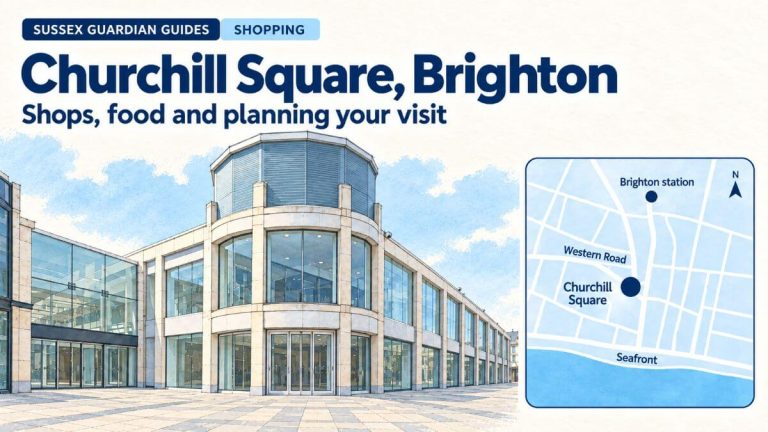










Churchill Square has been part of central Brighton for more than half a century, but the shopping centre people know today is very different from the development that opened in 1968.
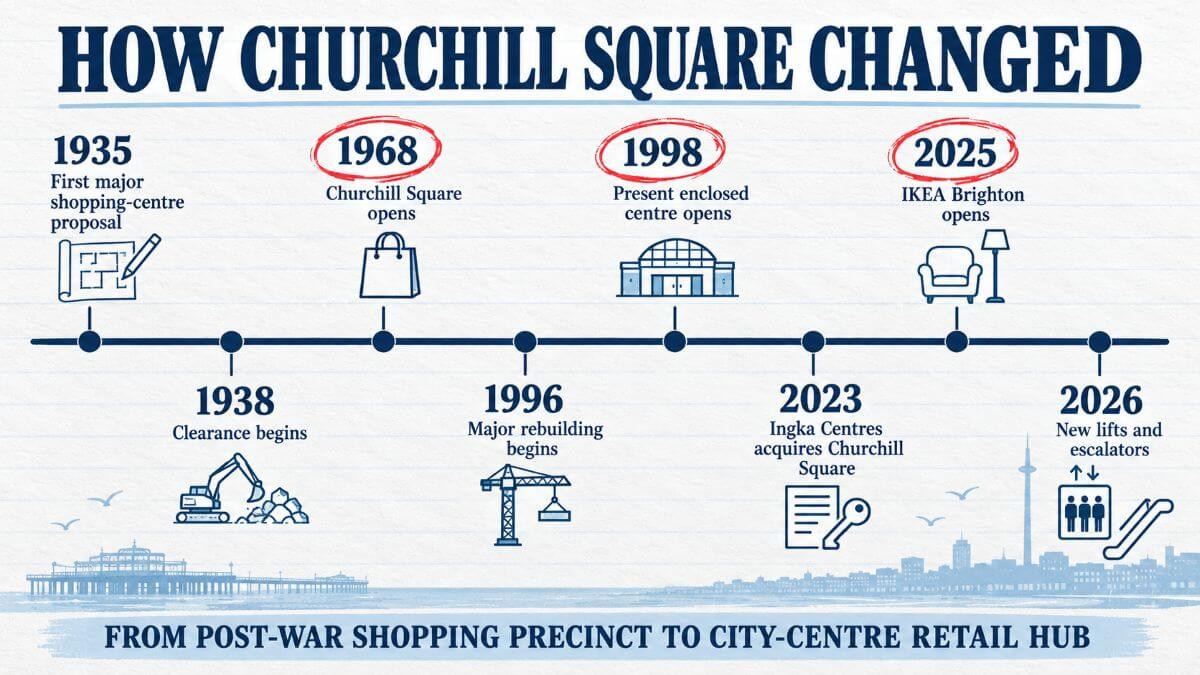
For anyone trying to work out exactly how old Churchill Square is, there are actually two important dates. The original shopping development was formally opened on 11 October 1968, while the present enclosed shopping centre opened 30 years later, in September 1998.
The story stretches back further still. Creating Churchill Square involved clearing older Brighton streets and reshaping a substantial area between Western Road and the seafront. Its later reconstruction would again have consequences for shopping elsewhere in the city.
Churchill Square history at a glance
Original plans: 1935
First shop: Blackburns menswear, June 1967
Original Churchill Square opened: 11 October 1968
Later multi-level section: 1971–72
Original centre demolished: Work began January 1996
Present shopping centre opened: September 1998
Current freeholder: Ingka Centres, acquired November 2023
When did Churchill Square open?
Churchill Square was formally opened on 11 October 1968 by Brighton’s then mayor, Thomas Taylor.
That does not mean everything appeared at once. Work on the main Churchill Square site had begun in 1965 and Blackburns menswear became the development’s first shop when it opened in June 1967. Most of the other shops in that phase followed in autumn 1968.
The development then continued southwards. Additional multi-level sections opened during 1971 and 1972.
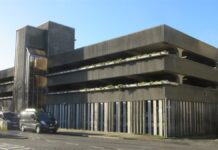
Churchill Square was a major departure from the Brighton which had developed around traditional shopping streets. The wider development combined shops with offices, housing and multi-storey car parks as part of a much larger redevelopment between Western Road and King’s Road.
What was there before Churchill Square?
The idea of creating a new shopping and entertainment centre in this part of Brighton was first conceived in 1935.
Some demolition came remarkably early. Buildings in Blucher Place and Upper Russell Street were cleared in 1938, but the Second World War prevented the redevelopment from progressing and the cleared land was largely used as a car park.
Further clearance took place around Artillery Street, Cannon Street and Russell Street in 1957 and 1958. Brighton council decided in 1959 to pursue redevelopment of the wider area and, following a public inquiry, ministerial approval was granted in January 1963.
The approved scheme covered about 15 acres between Western Road and King’s Road and extended well beyond what shoppers today would think of simply as Churchill Square.
Not all of the land was empty. Among the places lost was Grenville Place, an early 19th-century street of cobble-fronted buildings. Its name survived in Grenville House and in the service road associated with the later development.
Other older streets and properties disappeared as planners attempted to create a comprehensively designed commercial and entertainment district between Brighton’s main shopping streets and the seafront.
Why was the old Churchill Square demolished?
The original development did not enjoy the same success throughout its life.
By the early 1980s there were concerns about declining trade on its lower shopping levels. Major names gradually departed and by the beginning of the 1990s parts of the complex were struggling.
The last shop on the lower level closed in late 1993. Brighton council sold its interest to Standard Life in 1995 as plans advanced for a very different Churchill Square: a modern covered shopping centre.
Demolition began in January 1996 and construction of the replacement followed that August.
The new Churchill Square opened in September 1998. Instead of trying to revive the original 1960s layout, the project established the enclosed shopping mall which forms the basis of the centre Brighton has today.
| Year | What happened at Churchill Square? |
|---|---|
| 1935 | A new shopping and entertainment centre for the area is first conceived. |
| 1938 | Buildings in Blucher Place and Upper Russell Street are cleared, but the Second World War subsequently halts progress. |
| 1957–58 | Further clearance takes place around Artillery Street, Cannon Street and Russell Street. |
| 1959 | The council decides to pursue redevelopment of the wider site. |
| 1963 | Ministerial approval is granted for the 15-acre redevelopment. |
| 1965 | Work begins on the main Churchill Square development. |
| 1967 | Blackburns menswear becomes its first shop, opening in June. |
| 1968 | Churchill Square is formally opened on 11 October. |
| 1971–72 | The additional multi-level development opens. |
| 1993 | The final shop on the declining lower shopping level closes. |
| 1995 | Brighton council sells its interest to Standard Life ahead of redevelopment. |
| 1996 | Demolition begins in January, followed by construction of the replacement centre from August. |
| 1998 | The present enclosed Churchill Square opens in September. |
| 2023 | Ingka Centres acquires the freehold of Churchill Square. |
| 2025 | IKEA Brighton opens in the former Debenhams premises. |
| 2026 | A relocated H&M introduces H&M HOME to Brighton as further changes continue within the centre. |
How Churchill Square changed shopping in Brighton
The effect of the 1998 redevelopment was felt beyond the walls of the new shopping centre.
One of the most significant casualties of Brighton’s changing retail landscape was Hanningtons. The independent department store had roots in the city stretching back to 1808 and occupied a collection of buildings around North Street.
Brighton & Hove Museums says the redevelopment of Churchill Square hastened Hanningtons’ decline. The historic department store eventually closed on 30 June 2001.
Its disappearance reflected a wider shift in Brighton shopping. Large national retailers became concentrated in the modern Churchill Square, while the city’s older shopping streets faced changing consumer habits and competition from the new mall.
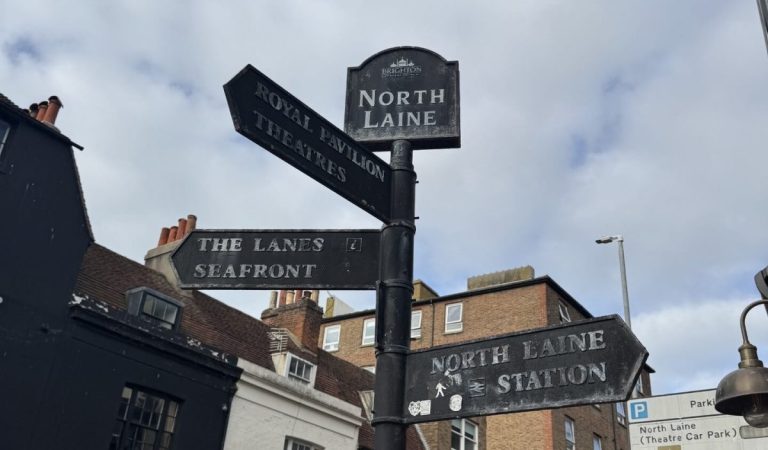
Yet Brighton did not become a conventional shopping-centre city. The Lanes and North Laine developed their own strong identities around smaller shops, independent businesses, restaurants, vintage clothing and specialist retail. Western Road also remained an important shopping street linking central Brighton with Hove.
That contrast remains one of the distinctive features of shopping in Brighton today: a large enclosed mall sits within walking distance of shopping districts which look and feel markedly different.
Who owns Churchill Square now?
Another major change came in November 2023 when Ingka Centres acquired the freehold of Churchill Square.
Ingka Centres is part of Ingka Group, which also includes IKEA Retail. The acquisition was accompanied by plans to bring IKEA into the former Debenhams premises, giving the Swedish retailer a major city-centre presence in Brighton.
IKEA Brighton subsequently opened in August 2025.
IKEA Retail operates the IKEA store, while Ingka Centres owns and manages Churchill Square itself.
Ingka Centres describes destinations such as Churchill Square as “Meeting Places”, reflecting an approach intended to bring together shopping with food, services, events and other reasons to visit.
Churchill Square is still changing
The arrival of IKEA is another chapter in a site which has repeatedly changed with Brighton’s retail economy.
The open shopping development created during the 1960s was substantially replaced after less than 30 years. Debenhams, once one of the defining stores of the rebuilt centre, has itself disappeared and its former premises now house IKEA.
Other recent changes have included the Local Hero rotating retail space, H&M’s relocation and introduction of H&M HOME, longer centre opening hours and work to replace ageing lifts and escalators.
Churchill Square therefore tells a wider story about Brighton. The shops have changed and the buildings have changed, but the debate about how this prominent piece of the city centre should work has continued across generations.
Frequently asked questions
Did Churchill Square open in 1968 or 1998?
Both dates are correct. The original Churchill Square was formally opened on 11 October 1968. Most of that development was later demolished and the present enclosed shopping centre opened in September 1998.
What was Churchill Square like originally?
The original development was very different from today’s enclosed mall. It included an open pedestrian shopping area, with additional multi-level shopping sections, offices, housing and car parks forming part of the wider complex.
What was there before Churchill Square?
The development replaced older streets and buildings as well as land which had already been cleared. Grenville Place, an early 19th-century street containing cobble-fronted buildings, was among the areas demolished for the scheme.
What was the first shop at Churchill Square?
Blackburns menswear was the first shop in the new development. It opened in June 1967, more than a year before Churchill Square’s formal opening.
Why was the original Churchill Square demolished?
Trade on the lower levels declined during the 1980s and early 1990s and major retailers left. The last lower-level shop closed in 1993. Plans subsequently progressed for a new covered centre, with demolition beginning in January 1996.
When did the current Churchill Square open?
The rebuilt enclosed shopping centre opened in September 1998.
Who owns Churchill Square?
Ingka Centres acquired Churchill Square’s freehold in November 2023. Ingka Centres is part of Ingka Group, which also includes IKEA Retail.
When did IKEA Brighton open?
IKEA Brighton opened at Churchill Square in August 2025, occupying the former Debenhams premises.
You May Also Be Interested In