





















Parents across Sussex can face an £80 penalty notice for unauthorised school absence, with a five-day term-time holiday enough to reach the national threshold at which a fine must be considered. The rules come against a difficult local attendance picture, with Brighton & Hove recording one of the highest absence rates in England.
The school absence fine system applies across Brighton & Hove, East Sussex and West Sussex, although the relevant local authority administers penalty notices in its own area.
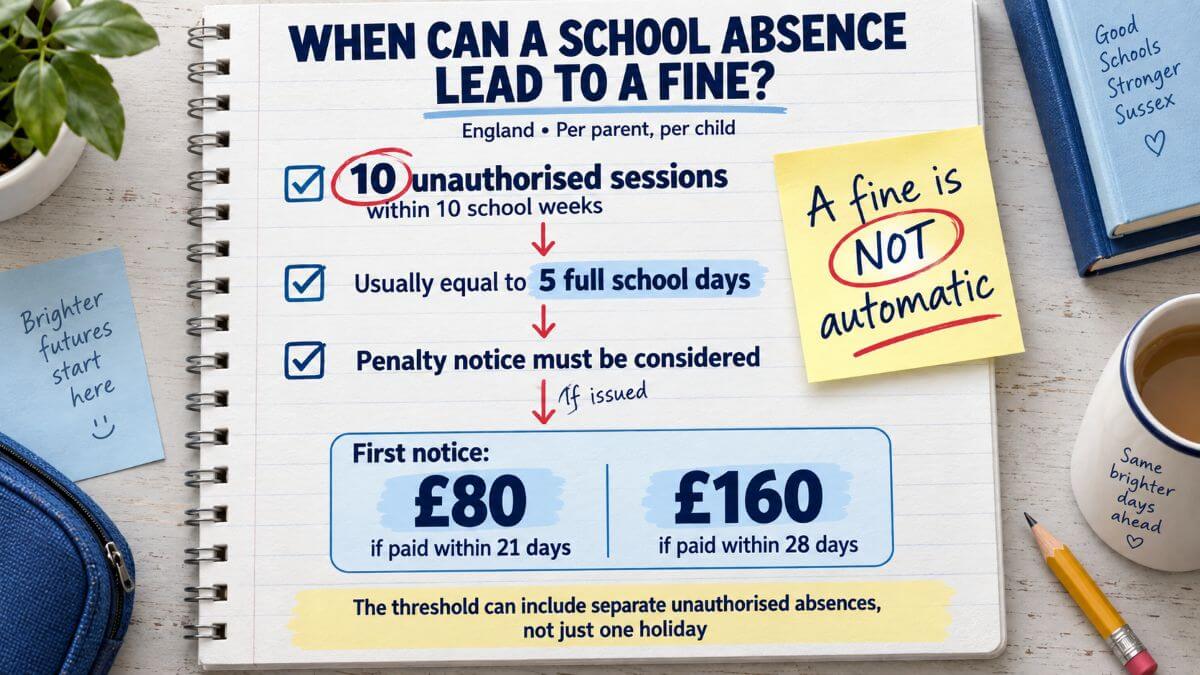
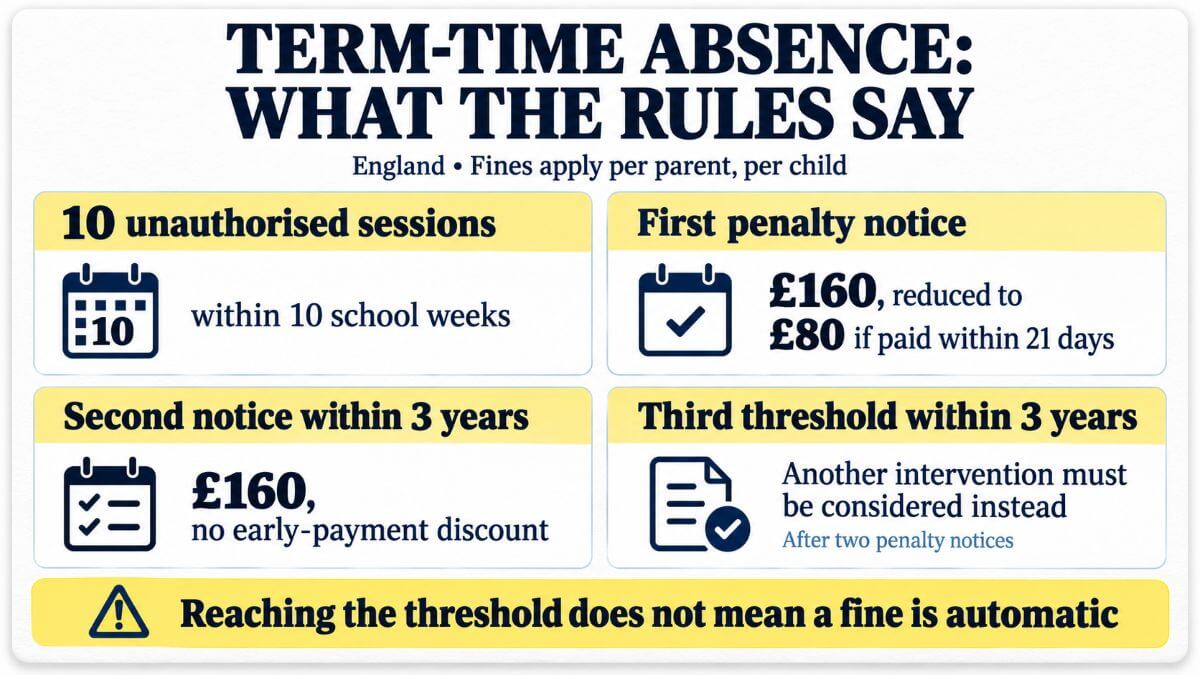
The main rules are national, with a threshold for penalty notices. A first penalty notice is £80 per parent, per child when paid within 21 days. It rises to £160 if paid after 21 days but within 28 days.
A second penalty notice issued to the same parent for the same child within three years is £160, with no reduced rate. A third penalty notice cannot be issued within that three-year period, meaning another intervention has to be considered instead.
The rules are particularly relevant in Sussex because school attendance remains below pre-pandemic levels. The latest complete Department for Education figures show particularly high absence in Brighton & Hove and East Sussex.
School absence fines
A five-day holiday can reach the national threshold
Schools normally record attendance twice each day. Five full school days therefore usually equal 10 sessions, which is the national threshold at which a state-funded school must consider whether a penalty notice is appropriate.
School absence fines in Sussex at a glance
| First penalty notice | £80 per parent, per child if paid within 21 days |
| First notice after 21 days | £160 if paid within 28 days |
| National threshold | 10 unauthorised sessions within a rolling period of 10 school weeks |
| Five-day holiday | Normally equals 10 school sessions and can therefore reach the threshold |
| Second notice | £160 for the same parent and child within three years |
| Third occasion | A third penalty notice cannot be issued within the three-year period; another intervention must be considered |
| Who authorises absence? | The school decides whether leave can be authorised |
| Cheaper holidays | A desire for a holiday or leisure trip is not normally considered an exceptional circumstance |
Penalty notices sit within a wider legal framework for school attendance in England. Parents are responsible for making sure a child of compulsory school age receives suitable full-time education, either at school or otherwise.
Where attendance problems continue, a penalty notice is not the only possible sanction. Depending on the circumstances, councils and schools may consider other routes including prosecution, an education supervision order, a parenting order or further attendance support.
Can parents be fined for taking children on holiday during term time?
Yes, where the absence has not been authorised.
Parents should ask the school for permission before arranging leave during term time. There is no general right to take a child out of school for a family holiday.
Department for Education guidance says leave may be granted where the school considers there are exceptional circumstances, but a need or desire for a holiday or other leisure activity would not normally qualify.
Families can use the Sussex school term dates to identify the published holiday periods before arranging travel.
That means cheaper flights, lower hotel prices, avoiding peak-season charges or finding more convenient travel dates do not normally create an entitlement to term-time leave.
If permission is refused and the child is taken out of school anyway, the absence can be recorded as unauthorised.
Brighton & Hove City Council tells parents to speak to their child’s school about an absence and says children can miss school where they are too ill to attend, are travelling to or from a medical appointment, or where an application has been made in advance and permission has been granted.
Can a five-day term-time holiday trigger a school fine?
Yes. The national threshold is 10 unauthorised sessions within a rolling period of 10 school weeks.
A school day normally contains two attendance sessions, one in the morning and one in the afternoon. Five complete days of unauthorised absence will therefore usually amount to 10 sessions.
The sessions do not have to come from one continuous holiday. Separate periods of unauthorised absence can accumulate towards the threshold during the rolling 10-school-week period.
The period can also span different terms and school years.
Important Point
Reaching 10 sessions does not make a fine automatic
The threshold means a state-funded school must consider whether a penalty notice is appropriate. The circumstances of the individual case still have to be considered. For an unauthorised holiday, however, a penalty notice may be the expected response once the national threshold is met.
A school or local authority still has to make a decision based on the details of the case. That decision may consider the reasons for absence, previous warnings or notifications, whether support has been offered, and whether a penalty notice is the right response.
How much is a school absence fine in Sussex?
The same national penalty levels apply in Brighton & Hove, East Sussex and West Sussex.
| Situation | Fine or action |
|---|---|
| First notice, paid within 21 days | £80 per parent, per child |
| First notice, paid after 21 days but within 28 days | £160 per parent, per child |
| Second notice for the same parent and child within three years | £160, with no £80 early-payment rate |
| Third occasion within three years | No third penalty notice can be issued; another intervention must be considered |
Is the £80 fine per family or per child?
Penalty notices are issued per parent, per child.
This can make a considerable difference to the total cost for a family with more than one child.
| Example | First penalty notices if paid within 21 days |
|---|---|
| One parent, one child | £80 |
| Two parents, one child | £160 |
| One parent, two children | £160 |
| Two parents, two children | £320 |
| Two parents, three children | £480 |
These examples assume each relevant parent receives a notice for each child and that all first notices are paid within the 21-day reduced-rate period.
A penalty notice should therefore not be treated as a £80 fee for permission to take a holiday. It is an attendance enforcement measure issued after an absence has been recorded as unauthorised.
Why school attendance is a particular issue in Sussex
The latest complete Department for Education statistics provide an important local context for the tougher national attendance regime.
Across England, pupils missed 6.78% of possible school sessions during 2024/25. Some 18.14% of pupil enrolments were persistently absent, meaning they missed at least 10% of their possible sessions.
Brighton & Hove and East Sussex both recorded higher overall absence than England as a whole.
| Area | Overall absence | Persistent absence | Severe absence | Overall absence ranking |
|---|---|---|---|---|
| Brighton & Hove | 8.0% | 21.2% | 3.2% | 4th highest of 153 local authorities |
| East Sussex | 7.6% | 20.8% | 3.1% | 12th highest of 153 |
| West Sussex | 6.8% | 17.6% | 2.3% | 71st highest of 153 |
| England | 6.78% | 18.14% | 2.39% | National comparison |
The figures cover state-funded primary, secondary and special schools and include authorised as well as unauthorised absence. They should therefore not be read as figures for truancy or term-time holidays alone.
Illness remains the largest single reason for school absence nationally.
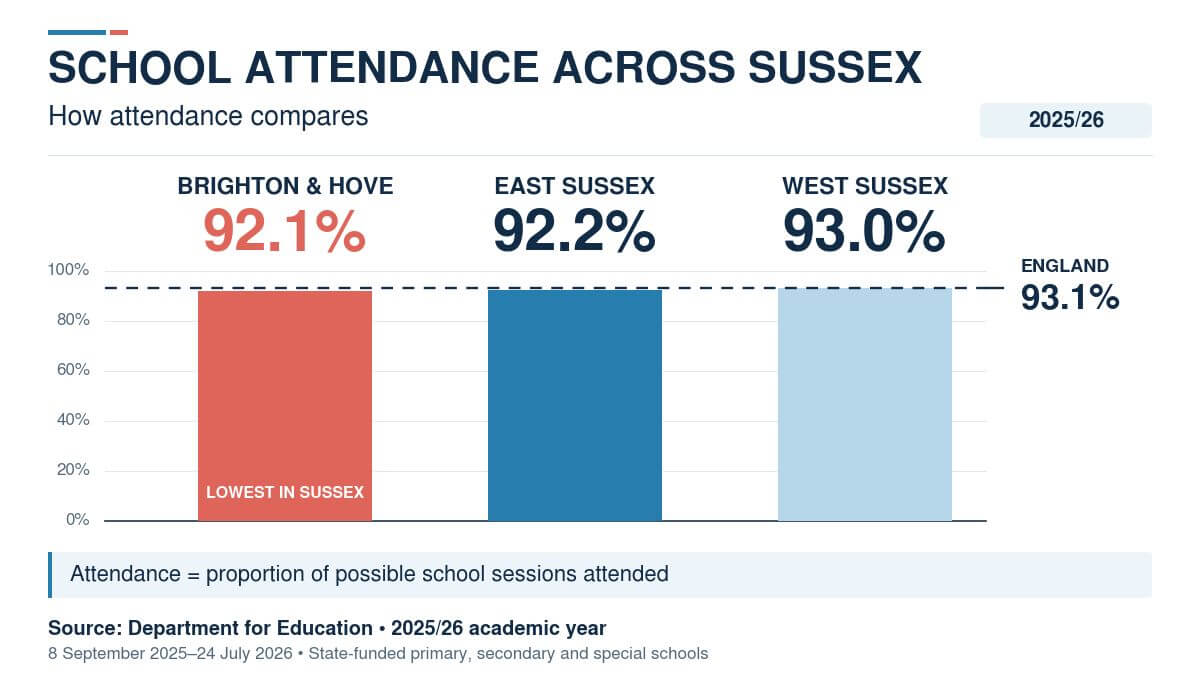
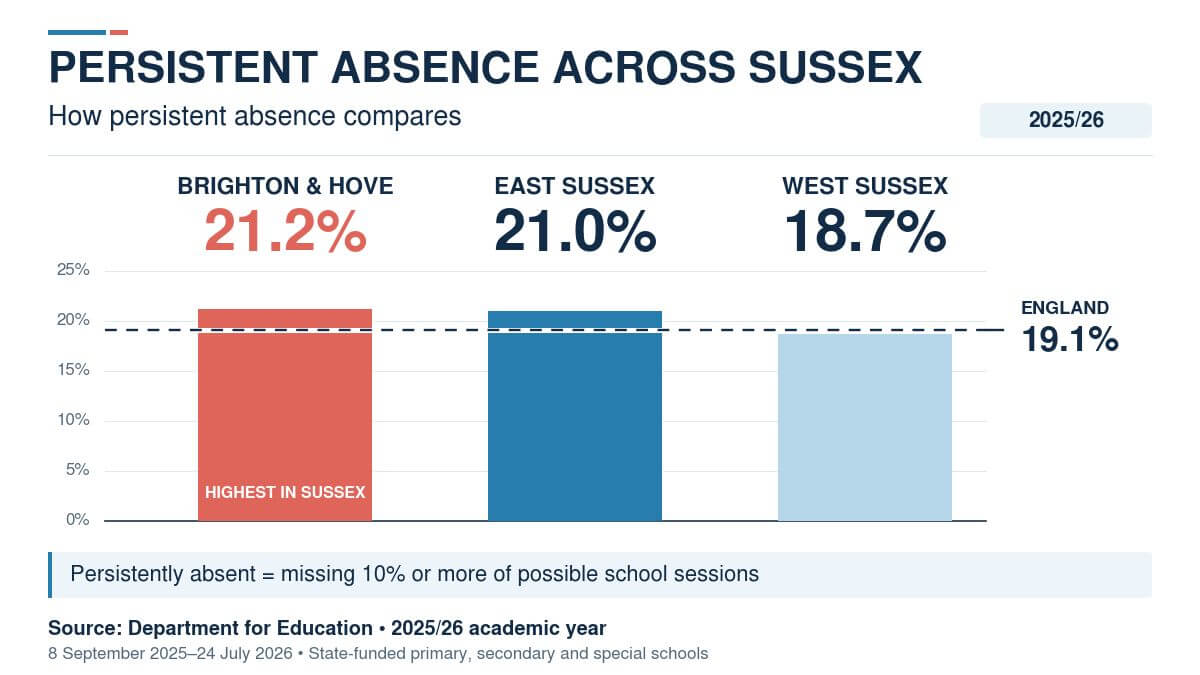
The 2025/26 Department for Education attendance data shows Brighton & Hove and East Sussex remained above the England average for overall absence and persistent absence. Brighton & Hove pupils missed 7.9% of possible school sessions, compared with 6.93% across England, placing the city eighth highest among local authorities with usable data. East Sussex recorded 7.8%, while West Sussex was much closer to the national picture at 7.0%.
| Area | Overall absence | Persistent absence | Overall absence ranking |
|---|---|---|---|
| Brighton & Hove | 7.9% | 21.2% | 8th highest of 151 local authorities with usable data |
| East Sussex | 7.8% | 21.0% | 16th highest of 151 |
| West Sussex | 7.0% | 18.7% | 66th highest of 151 |
| England | 6.93% | 19.05% | National comparison |
Brighton & Hove has one of England’s highest school absence rates
The Brighton & Hove figures stand out.
Pupils at state-funded primary, secondary and special schools in the city missed 8.0% of all possible sessions in 2024/25.
That placed Brighton & Hove fourth highest among the 153 local authorities reporting data, behind only Knowsley, Bradford and Southampton.
Some 792,013 school sessions were recorded as missed out of around 9.9 million possible sessions.
Persistent absence affected 5,933 pupil enrolments, or 21.2%, compared with 18.14% nationally.
Another 902 enrolments, or 3.2%, were severely absent, meaning at least half of their possible sessions were missed.
There is some evidence of improvement. Brighton & Hove’s overall absence rate fell slightly from 8.1% in 2023/24 to 8.0% in 2024/25, while persistent absence fell from 22.3% to 21.2%.
But the longer-term comparison remains striking. Before the pandemic, persistent absence in Brighton & Hove stood at 11.5% in 2018/19. The 2024/25 rate remained almost twice that level.
What the statistics mean
High absence does not mean 8% of pupils are skipping school
The overall absence rate measures the share of all possible school sessions that were missed. It includes authorised absence such as illness as well as unauthorised absence. Persistent absence means a pupil enrolment missed at least 10% of its possible sessions, whatever the recorded reason.
East Sussex also has above-average absence
East Sussex recorded the 12th-highest overall school absence rate among English local authorities in 2024/25.
Pupils missed 7.6% of possible sessions, compared with 6.78% nationally.
Persistent absence affected 20.8% of pupil enrolments, while 3.1% were severely absent.
Again, there was improvement compared with the previous academic year. Overall absence fell from 8.2% in 2023/24 to 7.6% in 2024/25, while persistent absence dropped from 23.1% to 20.8%.
East Sussex County Council nevertheless continues to treat attendance as a strategic priority. Its 2026–28 attendance plan includes objectives to reduce severe absence, reduce persistent absence in secondary and special schools and improve primary and secondary attendance in the Eastbourne and Hailsham area.
West Sussex is closer to the national picture
West Sussex recorded lower absence than its Sussex neighbours.
Its overall absence rate was 6.8% in 2024/25, effectively in line with the England figure.
Persistent absence stood at 17.6%, below the national rate of 18.14%, while severe absence was 2.3%, also slightly below the England figure.
There was improvement from 2023/24, when overall absence was 7.0% and persistent absence 19.0%.
That does not mean attendance is no longer a concern. West Sussex continues to identify attendance as a priority and has updated schools on the Department for Education’s statutory attendance guidance and resources for tackling the underlying causes of absence.
What does ‘persistent absence’ actually mean?
A pupil is considered persistently absent when they miss 10% or more of their possible school sessions.
This is different from the 10-session penalty-notice threshold.
The two figures sound similar but measure different things.
Do not confuse these two rules
10 sessions and 10% are not the same thing
Penalty-notice threshold: 10 unauthorised sessions within a rolling 10 school weeks.
Persistent absence: missing 10% or more of all possible sessions over the period being measured. Persistent absence includes authorised as well as unauthorised absence.
A child can therefore be persistently absent because of repeated illness or other authorised absences without those absences themselves creating grounds for a holiday penalty notice.
What counts as exceptional circumstances?
There is no automatic right to take a family holiday during term time.
Schools consider applications individually. Department for Education guidance says a need or desire for a holiday or other leisure activity would not generally amount to an exceptional circumstance.
Where genuinely exceptional circumstances affect a family, parents should give the school as much information as possible and apply before the proposed absence.
Do not assume that submitting a request means permission has been granted. Leave cannot simply be authorised retrospectively because travel has already been booked.
What if absence is caused by illness, SEND or mental health?
Attendance problems are not synonymous with family holidays.
Illness, disability, special educational needs, mental-health difficulties and other barriers can all affect a child’s ability to attend school.
The national attendance framework expects schools and local authorities to understand barriers to attendance and provide support where that is appropriate. Schools must also take account of relevant equality duties.
Parents should report illness and other absences using their school’s normal procedure and remain in contact.
Attendance concerns can also be linked to bullying, behaviour issues, exclusions, transport problems, safety concerns, anxiety, disability or wider family circumstances. Those cases should be handled differently from a straightforward unauthorised term-time holiday.
Parents should keep written records of conversations with the school, including dates, reasons given for absence and any advice or support offered by attendance or education services.
What happens if a school absence fine is not paid?
If a penalty notice is issued and not paid within the required period, the local authority can consider prosecution through the magistrates’ court.
That does not mean every unpaid notice automatically leads to court, but parents should not ignore a penalty notice or warning letter. The notice will set out the payment deadline, the child concerned, the relevant parent and the next steps if payment is not made.
Can parents appeal a school absence fine?
Penalty notices are not usually appealed in the same way as a parking ticket. Parents who believe a notice has been issued incorrectly should contact the school or local authority quickly and follow the process set out in the notification.
Common issues to check include whether the absence was correctly recorded, whether the child was of compulsory school age, whether the right parent has been named and whether the sessions fall within the relevant 10-school-week period.
Is school absence a criminal offence?
Parents have a legal responsibility to make sure a child of compulsory school age receives suitable education. In serious or unresolved attendance cases, local authorities can consider prosecution, although many cases are handled first through warnings, support, penalty notices or other interventions.
What is an education supervision order?
An education supervision order is a court order that can be used where a child is not receiving suitable education. It is separate from a penalty notice and is usually considered as part of a wider response to persistent attendance concerns.
Can bullying or safety concerns affect attendance decisions?
Yes. If absence is linked to bullying, safety, behaviour, exclusion, transport or SEND-related issues, parents should raise this with the school as early as possible. Those reasons may affect what support is appropriate and whether enforcement action is proportionate.
You May Also Be Interested In