


















Thousands more children across East Sussex, West Sussex and Brighton & Hove can qualify for free school meals from September 2026 after eligibility was expanded to all households receiving Universal Credit, regardless of earnings.
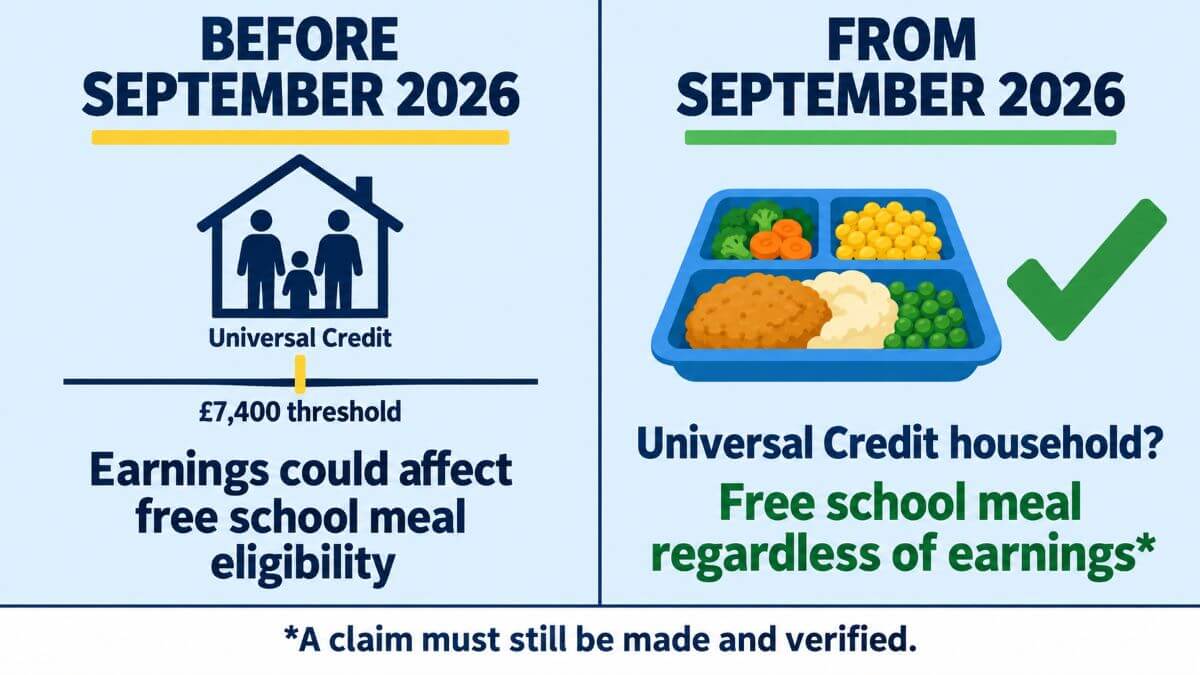
The biggest change is that the old £7,400 annual household earnings threshold no longer decides whether a Universal Credit household can receive the meal itself.
Instead, the threshold now determines which of two benefits-based free school meal categories applies: Targeted Free School Meals or Expanded Free School Meals.
Both provide a free school meal. The difference is that Targeted FSM remains linked to additional support including pupil premium funding for schools, the Holiday Activities and Food programme and some school-travel entitlements. Expanded FSM is a meals-only category.
The Department for Education estimates that more than 500,000 additional children across England will become eligible to claim free school meals following the expansion.
Free school meals are primarily about access to a healthy school lunch, but the policy also sits within a wider welfare and inclusion system. For many families, the entitlement reduces pressure on household food budgets while helping pupils access a regular meal during the school day. Breakfast clubs, holiday food provision and other nutrition initiatives may have separate rules.
The key change
Universal Credit now qualifies regardless of earnings
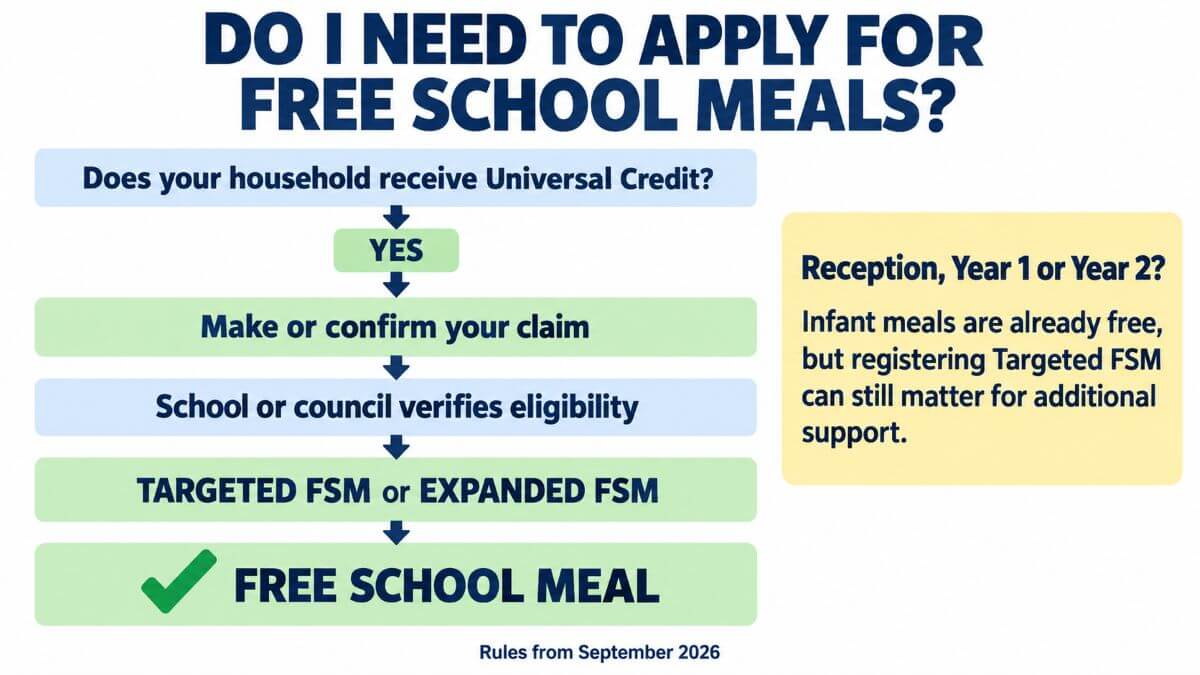
If your household receives Universal Credit, your child can qualify for free school meals regardless of household earnings. A claim must still be made and the entitlement verified by the school or local authority.
Free school meals in Sussex at a glance
| Your circumstances | What the rules mean from September 2026 |
|---|---|
| Your household receives Universal Credit | Your child can qualify for a free school meal regardless of household earnings, once a claim has been made and verified. |
| Universal Credit household earnings are £7,400 a year or less | The child falls within Targeted Free School Meals. |
| Universal Credit household earnings are above £7,400 a year | The child falls within Expanded Free School Meals. |
| Your child is in Reception, Year 1 or Year 2 | They already receive Universal Infant Free School Meals, but registering Targeted FSM eligibility can still help their school receive additional funding. |
| Your child is moving from Year 2 into Year 3 | A verified benefits-based claim is important because Universal Infant Free School Meals end after Year 2. |
| Your child attends eligible school-based nursery provision | They may qualify if they meet the benefits criteria and attend full-time, or attend both before and after lunch when part-time. |
| Your family has no recourse to public funds | Your child may qualify under separate immigration-status and household-income rules. |
| Your child already received benefits-based free school meals | Eligibility should be rechecked under the new Targeted and Expanded categories. |
What changed from September 2026?
Before the 2026/27 academic year, Universal Credit households generally had to remain within an annual household earnings threshold of £7,400 to qualify for benefits-based free school meals.
From the start of the 2026/27 academic year, children from households receiving Universal Credit can qualify for a free school meal regardless of household earnings.
The £7,400 threshold still matters, but for a different reason. Department for Education guidance now divides benefits-based free school meals into two categories.
| Type | Who it covers | Free meal? | Linked support |
|---|---|---|---|
| Targeted Free School Meals | Universal Credit households with annual household earnings of £7,400 or less, plus certain other qualifying groups | Yes | Can attract pupil premium and other disadvantage funding; remains the basis for HAF and extended-rights school travel |
| Expanded Free School Meals | Universal Credit households above the £7,400 earnings threshold | Yes | Meals only; does not by itself create pupil premium, HAF or extended-rights travel eligibility |
| Universal Infant Free School Meals | All pupils in Reception, Year 1 and Year 2 at state-funded schools | Yes | Does not by itself create benefits-based eligibility or pupil-premium status |
Targeted FSM can also apply through other qualifying routes, including certain income-related benefits, asylum support and separate provisions for some families with no recourse to public funds.
Families still need to make a claim
The wider entitlement does not mean every Universal Credit household is automatically added to the school meal system.
Department for Education guidance says a child is eligible to receive the meal only when a claim has been made and the school or local authority has verified that eligibility.
A Universal Credit award by itself does not necessarily tell the school to begin serving free meals.
Families should treat the application as a school meals check rather than a simple lunch request. The school or council uses the application form to confirm eligibility, record whether the child falls under Targeted FSM or Expanded FSM, and make sure the correct status is in place before the school census. From September 2026, the Department for Education says FSM eligibility should be rechecked annually ahead of the October census.
Do not assume it is automatic
Make sure the claim has been verified
If your household receives Universal Credit and you have not received confirmation of your child’s free school meal status for 2026/27, check with the school or relevant council.
Eligibility is expected to be rechecked regularly. The Department for Education says annual rechecks should confirm both whether the child remains eligible and whether they fall into the Targeted or Expanded category.
How to apply for free school meals in Sussex
The correct application route normally depends on where the child attends school rather than simply where the family lives.
| Area | Where to apply | What to know |
|---|---|---|
| East Sussex | East Sussex County Council free school meals service | Most applications are handled by the council, although several academies process their own claims. |
| West Sussex | West Sussex County Council free school meals service | Online applications are available. Separate arrangements apply to eligible NRPF families. |
| Brighton & Hove | Brighton & Hove City Council free school meals application | The city application is for parents, carers and guardians of children attending schools in Brighton & Hove. |
Applying in East Sussex
East Sussex County Council identifies three main school-meal categories: Universal Infant Free School Meals, Targeted FSM and Expanded FSM.
The council says Targeted FSM covers Universal Credit households earning £7,400 a year or less, while Expanded FSM covers Universal Credit households above that threshold.
Most families apply through East Sussex County Council’s free school meals service, although the council lists some academies which handle applications directly. Families whose child attends a school outside East Sussex should follow the application arrangements for that school.
East Sussex says eligibility is checked annually and the result remains valid for the academic year.
| Application | East Sussex free school meals |
| Telephone | 0300 330 9472 |
| Published phone hours | 10am to 3pm |
Applying in West Sussex
West Sussex County Council has updated its eligibility guidance for the September 2026 changes.
The council says children living in households receiving Universal Credit can qualify for free school meals, with Targeted FSM used for households earning £7,400 or less and Expanded FSM for those above the threshold.
Applications can be made through the West Sussex County Council free school meals service.
Once a child receives Targeted or Expanded status, West Sussex says that status is retained until the end of the school year and checked again before the next academic year.
The council also says children who were already receiving free school meals were to have their eligibility checked under the new rules before September 2026, with schools notifying families of the outcome.
| Application | West Sussex free school meals |
| [email protected] | |
| Telephone | 0330 222 5555 |
Applying in Brighton & Hove
Brighton & Hove City Council provides an online application for parents, carers and guardians whose children attend a school in the city.
The form asks for contact and address details, a National Insurance number or National Asylum Seeker number and information about the child or children included in the application.
The city also provides a separate route for eligible families with no recourse to public funds.
Apply for free school meals in Brighton & Hove.
Where to apply
Free school meal applications in Sussex
East Sussex: Apply through East Sussex County Council for most schools. Some academies handle applications directly.
Brighton & Hove: Use Brighton & Hove City Council’s application service for children attending schools in the city.
West Sussex: Apply through West Sussex County Council. Online applications are available.
The application route usually follows where your child attends school, rather than simply where your family lives. Check your school’s instructions if you are unsure.
Why Reception, Year 1 and Year 2 parents should still register
All pupils in Reception, Year 1 and Year 2 at state-funded primary schools receive Universal Infant Free School Meals, regardless of household income.
Parents do not need to make a benefits-based claim simply to receive that infant meal.
However, if the household meets the Targeted FSM criteria, it is still important to register. A Targeted FSM claim can help the school receive pupil premium and other disadvantage funding and can also affect access to schemes such as HAF.
Reception to Year 2
The meal may already be free, but registration can still matter
Universal Infant Free School Meals provide the meal automatically. A separate Targeted FSM claim can still generate additional funding for the school and can affect eligibility for linked support.
The issue becomes particularly important when a child moves into Year 3. Universal Infant Free School Meals end after Year 2, so a family receiving Universal Credit should ensure the benefits-based claim has been verified if they want the free meal to continue.
What are pupil premium and Ever 6?
Pupil premium is additional funding for schools intended to improve outcomes for disadvantaged pupils.
From September 2026, current Targeted FSM eligibility can place a pupil within the Ever 6 FSM cohort. This includes pupils who are currently eligible for Targeted FSM or who have held qualifying status during the previous six years.
Expanded FSM by itself does not generate new pupil-premium eligibility. A child who previously held qualifying FSM status may nevertheless continue to attract disadvantage funding through the Ever 6 rules.
Two different questions
Free meal entitlement is not the same as disadvantage funding
1. Is the child currently entitled to a free school meal?
2. Does the child attract pupil premium or other disadvantage funding through Targeted FSM or Ever 6?
Does Expanded FSM include HAF holiday clubs?
No, not automatically.
The Holiday Activities and Food programme remains based principally on Targeted FSM rather than the new Expanded FSM category.
Children who qualify for a free meal solely through Expanded FSM do not automatically gain HAF eligibility.
| Area | Programme | Main eligibility position |
|---|---|---|
| East Sussex | Holiday Food and Fun | Targeted FSM is the main qualifying route, with some additional provision possible under local criteria. |
| West Sussex | Holiday Activities and Food programme | Benefits-related or Targeted FSM remains the principal eligibility route. |
| Brighton & Hove | Holiday Activities and Food programme | Targeted FSM is the relevant free-school-meal category under the current city criteria. |
Local availability, discretionary places and booking arrangements can change, so families should check the current programme before assuming that a free school meal automatically provides a HAF place.
Does free school meal eligibility include free school transport?
No. School travel assistance is a separate scheme.
Targeted FSM can form part of the eligibility test for the extended-rights element of school travel assistance, but other conditions can apply, including the child’s age, distance from school and which school they attend.
Expanded FSM alone does not create an automatic right to free school transport. Families must apply separately through the relevant council’s school-transport system.
What happened to free school meal transitional protection?
Transitional protection operated during the rollout of Universal Credit from April 2018.
It meant that many pupils who became eligible for benefits-based free school meals retained that entitlement even if their household circumstances later changed.
Those protections ended at the end of the 2025/26 academic year.
From 2026/27, households must meet one of the current eligibility routes to continue receiving a free meal. A child who loses current meal eligibility may nevertheless continue attracting disadvantage funding through Ever 6 if they previously held qualifying status.
Free school meals FAQS
What is a school meals check?
A school meals check is the process used by a school or council to confirm whether a child qualifies for benefits-related free school meals. It can involve checking Universal Credit, Pension Credit guarantee element or other qualifying benefit information, then recording whether the child is covered by Targeted FSM or Expanded FSM.
Does free school meals eligibility include breakfast?
Not automatically. Free school meals usually refer to lunch during the school day. Breakfast clubs, holiday food programmes and other nutrition support can have separate eligibility rules, so families should check the school or council’s current programme.
Why does Targeted FSM matter if Expanded FSM also gives a meal?
Both categories provide a free meal, but Targeted FSM remains linked to extra school funding and some related support. Expanded FSM gives the meal itself but does not automatically create pupil premium, HAF or extended-rights travel eligibility.
You May Also Be Interested In