
















Drivers can face timed motor-vehicle restrictions outside schools across Brighton & Hove, East Sussex and West Sussex. This guide lists the affected roads, published operating times, camera rules, exemptions and the status of proposed or trial schemes.
School Streets restrict most motor vehicles from entering roads near school gates during signed morning drop-off and afternoon collection windows.
The schemes are intended to reduce congestion, unsafe parking and vehicle movements immediately outside schools, while creating a safer local environment for pupils, school staff, visitors, residents and families travelling on foot, by wheelchair or mobility aid, scooter or bicycle.
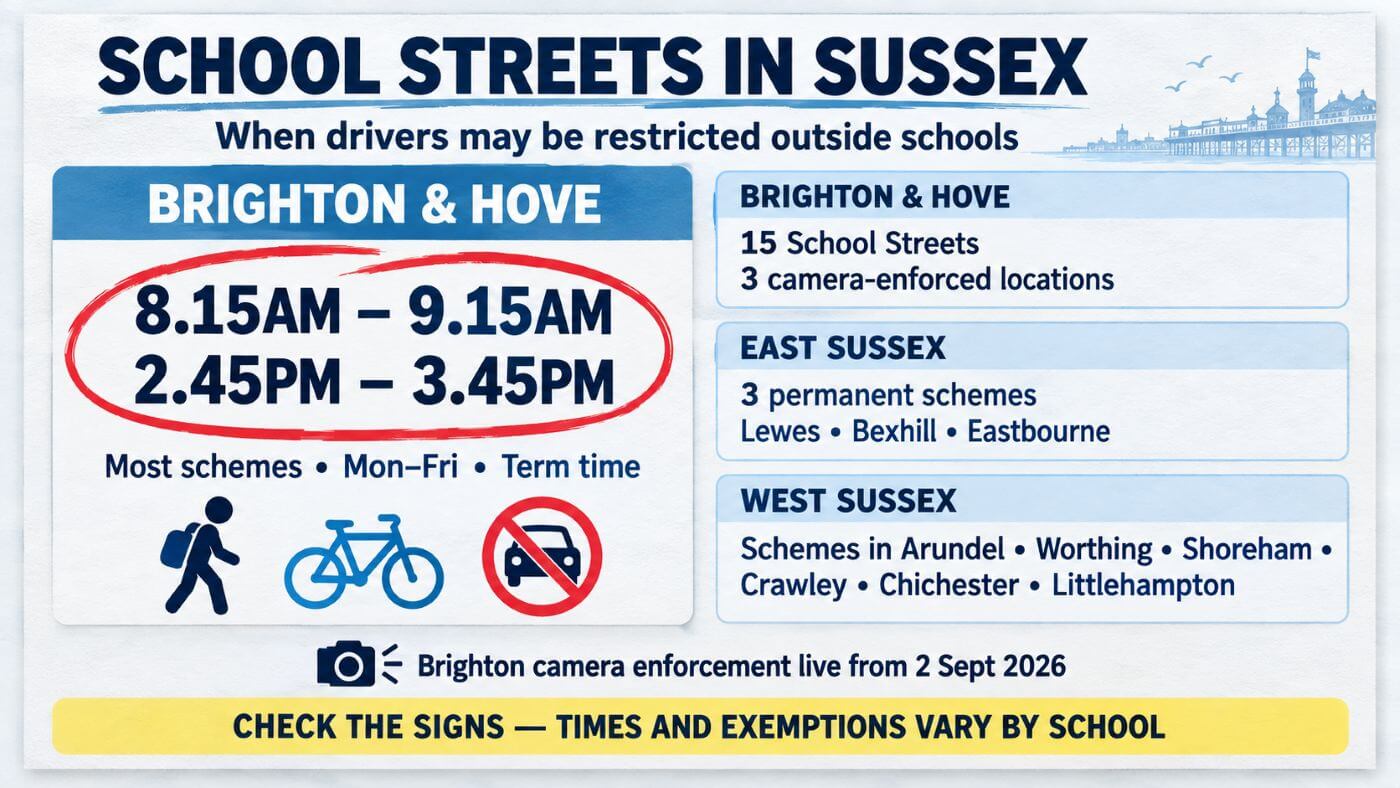
The rules are not identical across Sussex. Brighton & Hove has 15 established School Streets with largely standard city-wide hours. East Sussex has three permanent schemes with different times at each school. West Sussex has three permanent schemes from its original trial and a later programme covering Crawley, Chichester and Littlehampton.
Before you go
Always check the sign before entering
School Street arrangements can change. Drivers should follow the current restriction sign at the road entrance and check the relevant council’s live information before making a journey that depends on an exemption.
| Area or question | Current position |
|---|---|
| Brighton & Hove | 15 operational School Streets; camera enforcement introduced at three sites in September 2026 |
| East Sussex | Three permanent School Streets in Lewes, Sidley and Eastbourne |
| West Sussex | Three permanent schemes from the first trial, plus three locations in the later 2024/25 programme |
| Who is restricted? | Most motor vehicles entering during the signed time window |
| Can residents enter? | Usually, but an exemption or advance vehicle registration may be required |
| Do the restrictions operate in holidays? | Generally not; most apply during specified school-day periods in term time |
| Can drivers be fined? | Yes, where an enforceable restriction is breached |
What is a School Street?
A School Street is a road, part of a road or small group of roads where most motor vehicles are prohibited from entering at specified times around the beginning and end of the school day.
National School Streets guidance from the Department for Transport and Active Travel England describes the measure as a restriction on motorised traffic outside a school. It is better understood as a timed motor-vehicle restriction than as a conventional road closure.
Depending on the location, a scheme may use permanent or folding signs, temporary barriers, staffed gates or automatic number-plate recognition cameras.
People can continue to walk, use wheelchairs and mobility aids, scoot and cycle through the area. Vehicles covered by an approved exemption may also enter, although the categories and registration process differ between councils.
How it works
A School Street may look completely open
A road does not need a barrier or steward for the restriction to be legally in force. Drivers must follow the sign at the entrance even when the road looks open and nobody is physically preventing access.
School Streets in Brighton & Hove
Brighton & Hove has the largest School Streets network in Sussex. The city council’s current list contains 15 operational schemes, most of which use the same two restriction windows.
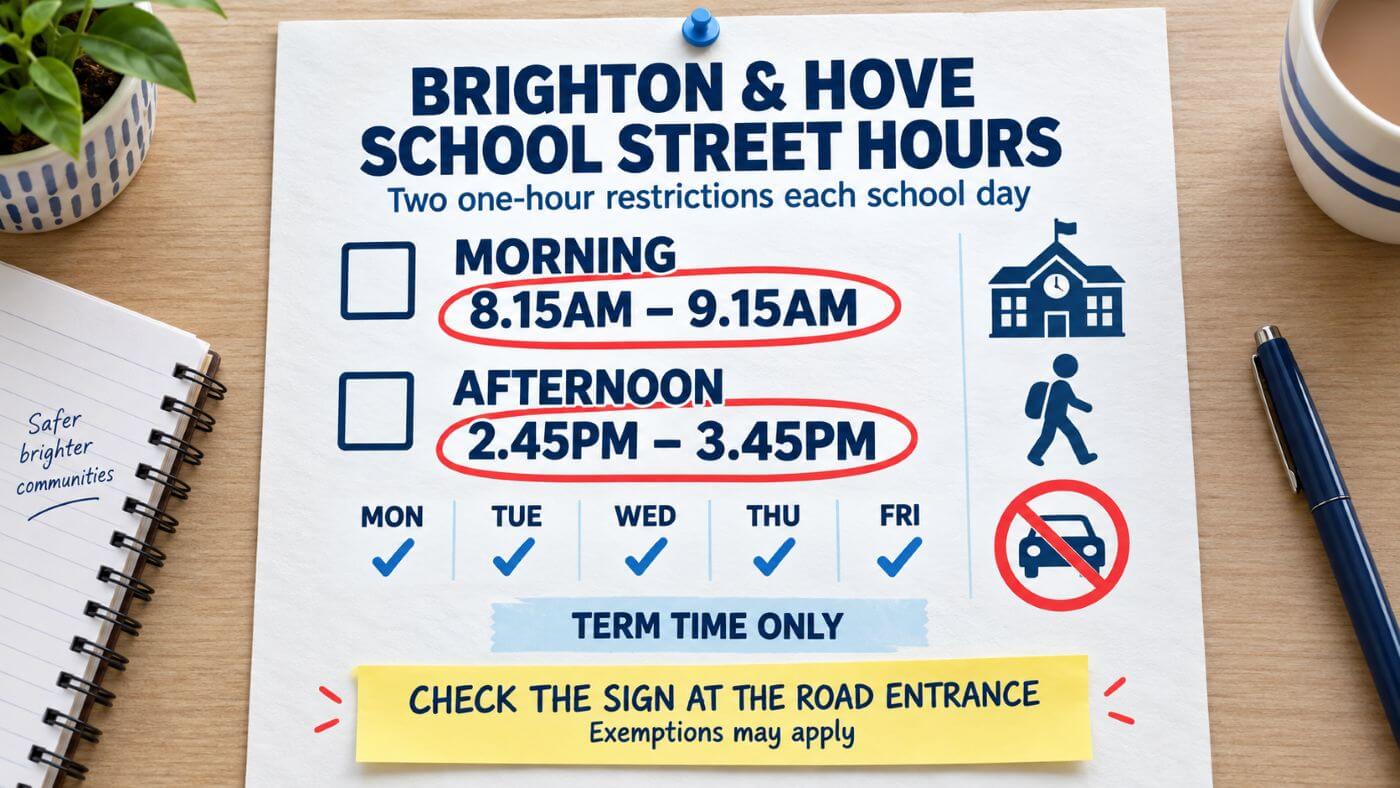
Brighton & Hove School Street hours
Two one-hour restrictions each school day
Morning: 8.15am to 9.15am
Afternoon: 2.45pm to 3.45pm
Days: Monday to Friday during term time
Motor vehicles cannot enter during those periods unless the vehicle or journey qualifies for an exemption. The council publishes current details on its Brighton & Hove School Streets page.
Current Brighton & Hove School Streets
| School | Road or roads affected |
|---|---|
| Aldrington CE Primary School | Eridge Road |
| Brunswick Primary School | Somerhill Road |
| Downs Infant School | Florence Place |
| Downs Junior School | Grantham Road |
| Fairlight Primary School | Hastings Road |
| Hangleton Primary School | Dale View and Northease Drive |
| Hove Junior School and West Hove Infant School | School Road and Marmion Road |
| Queen’s Park Primary School | Freshfield Place |
| Saltdean Primary School | School Lane |
| St Andrew’s CE Primary School | Haddington Street |
| St Luke’s Primary School | Queens Park Rise |
| St Mary’s Catholic Primary School | Vale Gardens |
| St Nicolas CE Primary School | Highlands Road |
| St Paul’s CE Primary School | St Nicholas Road and Church Street |
| Westdene Primary School | Barn Rise |
Three more Brighton School Streets were proposed in 2026
Brighton & Hove City Council consulted during summer 2026 on three additional School Street areas affecting six schools.
| Proposed area | Schools affected | Status checked 8 September 2026 |
|---|---|---|
| Woodingdean | Woodingdean Primary School | Proposed; consultation held in summer 2026 |
| West Blatchington and Hangleton | West Blatchington Primary School and King’s School | Proposed; consultation held in summer 2026 |
| Balfour area | Balfour Primary School, Varndean School and Dorothy Stringer School | Proposed; consultation held in summer 2026 |
These proposed areas were not part of the council’s established 15-site operational list when this guide was checked. Consultation, scheme approval and the final version of any traffic order can change before a proposal becomes operational.
Does King’s School in Hangleton have a School Street?
King’s School does not yet form part of Brighton & Hove’s 15 established School Streets, but it was included with West Blatchington Primary School in the proposed West Blatchington and Hangleton scheme consulted on during summer 2026.
That proposal should not be confused with Hangleton Primary School, which already has an operational School Street on Dale View and Northease Drive.
Hangleton explained
There are two separate schemes
Hangleton Primary School already has a School Street on Dale View and Northease Drive. King’s School and West Blatchington Primary School were included together in a separate proposed School Street around Hangleton Way.
Camera enforcement began at three Brighton School Streets
Brighton & Hove introduced camera enforcement at three existing School Streets from 2 September 2026:
- Hangleton Primary School, covering Dale View and Northease Drive
- Queen’s Park Primary School, covering Freshfield Place
- Hove Junior School and West Hove Infant School, covering School Road and Marmion Road
The cameras identify vehicles entering during the restricted time window. Where an exemption requires registration, the number plate must be added to the council’s authorised vehicle system. Further information is available through the council’s School Street camera-enforcement information.
Camera enforcement
Brighton has a six-month warning period
During the first six months after camera enforcement began, the registered keeper will normally receive a warning notice in the first instance rather than an immediate Penalty Charge Notice. A subsequent contravention can lead to a £70 PCN, reduced to £35 if paid within 21 days. The restriction remains in force throughout the warning period.
Who is exempt in Brighton & Hove?
Brighton & Hove City Council lists several categories that can qualify for access during restricted hours. They include:
- vehicles registered to residents or businesses within the restricted area;
- Blue Badge holders who need to reach a property inside it;
- Compass Card holders who require access;
- professional carers and carers for vulnerable residents;
- emergency-service and emergency utility vehicles;
- people working for a business or service within the street; and
- contracted school transport.
At camera-enforced locations, a qualifying vehicle may need to be registered in advance. Eligibility does not necessarily mean that a camera can identify the reason for the journey without prior registration.
Parking rules
An exemption is not a parking permit
Permission to enter a School Street does not override yellow lines, residents’ bays, school keep-clear markings, loading restrictions or any other parking controls.
School Streets in East Sussex
East Sussex County Council ran a six-week School Street trial in spring 2021 at Ark Blacklands Primary Academy and All Saints CE Junior Academy in Hastings, All Saints CE Primary School in Sidley, Southover CE Primary School in Lewes, Harbour Primary and Nursery School in Newhaven and Langney Primary Academy in Eastbourne.
The council reported fewer cars immediately outside participating schools and increases in some forms of walking, scooting and park-and-stride travel. Results varied between locations, and feedback from schools and local communities helped determine which schemes progressed.
Three locations were subsequently developed through experimental orders and became permanent in 2025. Background on the trial is available through East Sussex County Council’s School Streets information.
Permanent East Sussex School Streets
| School | Restricted road or roads | Morning restriction | Afternoon restriction | Status |
|---|---|---|---|---|
| Southover CE Primary School, Lewes | Potters Lane, Cleve Terrace and The Course | 8.20am to 8.50am | 3pm to 3.30pm | Permanent |
| All Saints CE Primary School, Sidley | All Saints Lane | 8.15am to 9am | 2.45pm to 4.15pm | Permanent |
| Langney Primary Academy, Eastbourne | Chailey Close and Redford Close | 8.15am to 8.45am | 2.45pm to 3.30pm | Permanent |
East Sussex does not use one county-wide timetable. Each Traffic Regulation Order sets the roads and hours for the individual scheme. The permanent Southover order came into effect in September 2025, followed by the permanent All Saints and Langney orders later that month.
Could East Sussex get more School Streets?
Further schemes remain possible, but no larger confirmed list of new permanent locations had been published when this guide was checked.
East Sussex has developed an assessment framework for future sites, subject to funding. The council considers school and community support, pupil numbers, road layout, traffic flow, collision records, public transport, existing parking controls, accessibility and the risk of moving traffic or parking into neighbouring roads.
School Streets in West Sussex
West Sussex County Council initially ran a School Street trial at Arundel CE Primary School, Thomas A Becket Junior School in Worthing and Swiss Gardens Primary School in Shoreham-by-Sea. Following the trial, all three restrictions were made permanent.
Permanent West Sussex School Streets
| School | Restricted road | Morning restriction | Afternoon restriction | Status |
|---|---|---|---|---|
| Arundel CE Primary School | Jarvis Road, Arundel | 8am to 9am | 3pm to 4pm | Permanent |
| Thomas A Becket Junior School | Glebeside Avenue, Worthing | 8am to 9am | 2.30pm to 3.30pm | Permanent |
| Swiss Gardens Primary School | Swiss Gardens, Shoreham-by-Sea | 8am to 9am | 2.30pm to 3.30pm | Permanent |
Further West Sussex School Street schemes
West Sussex expanded its Active Travel to School initiative to three further locations. Engagement and scheme development began in September 2024, and the council’s live programme page continues to list the sites separately from the three original permanent schemes.
| School | School location | Restricted road or roads named in published documents | Morning | Afternoon | Published programme position |
|---|---|---|---|---|---|
| The Mill Primary Academy | Ifield Drive, Crawley | Shipley Road, leading towards Southwater Close | 8am to 9am | 2.30pm to 4pm | Later 2024/25 programme; check the current TRO and roadside signs |
| St Joseph’s Infant and Junior Schools | Orchard Street, Chichester | Orchard Gardens | 8am to 9am | 2.30pm to 4pm | Later 2024/25 programme; check the current TRO and roadside signs |
| River Beach Primary School | York Road, Littlehampton | Connaught Road and Queens Street | 8am to 9.30am | 2.30pm to 4pm | Later 2024/25 programme; check the current TRO and roadside signs |
West Sussex County Council’s live School Streets page says feedback from schools and surrounding communities is central to its monitoring and evaluation. The council has used engagement with parents, residents, businesses, school staff and wider community groups, together with surveys and data collected before and during implementation.
The monitoring considers travel choices, traffic displacement, perceptions of safety at school gates, the surrounding environment, air quality, accessibility, local infrastructure, site suitability and the resources needed to operate each scheme.
West Sussex also said the programme would be supported by Sustrans and Living Streets through in-school activities intended to build children’s active-travel skills and knowledge.
Because feedback, public consultation and legal approval can alter the final version of a scheme, drivers should check the live council page, the current Traffic Regulation Order and the sign at the road entrance before relying on a published timetable.
Who can enter a School Street?
Exemptions differ between councils and sometimes between individual School Street schemes.
Categories that commonly qualify can include:
- residents and businesses within the restricted area;
- Blue Badge holders who need to reach a destination inside it;
- carers and some health or social-care workers;
- emergency-service and emergency utility vehicles;
- contracted school transport; and
- vehicles needed for students with particular access requirements.
An exemption may relate to a category of vehicle, a specific journey or an individual registration number. At camera-monitored locations, the vehicle may need to be registered before entering.
Residents and visitors
Residents living within a School Street can normally qualify for access, but the application process depends on the authority and enforcement method. Council-tax registration or an ordinary parking permit does not necessarily create an automatic camera exemption.
Some schemes also provide temporary access for visitors to a property within the zone. The resident or visitor may need to supply vehicle details in advance, so the relevant council process should be checked before the restricted window begins.
Blue Badge holders and accessible journeys
Blue Badge holders can qualify for exemptions where they need to reach a home, school, workplace or other destination inside the restricted area. Displaying a badge does not necessarily tell an enforcement camera that the vehicle is authorised.
National guidance says councils should consider accessibility and equality throughout scheme design, including the needs of disabled people and those who rely on motor-vehicle access.
School staff, parents, deliveries and tradespeople
Ordinary journeys by school staff or parents are not automatically exempt simply because the destination is a school. Another exemption may apply, for example, residence within the zone, a Blue Badge, school transport or a pupil’s specific access need.
There is no single Sussex-wide exemption for delivery drivers, taxis, private-hire vehicles or tradespeople. Some essential or authorised visits can qualify, while routine deliveries may need to be arranged outside the restricted periods.
Can a vehicle already parked inside leave?
A School Street mainly controls vehicles entering the restricted area. Vehicles already parked inside should usually be allowed to leave, although the exact rule depends on the wording and layout of the individual Traffic Regulation Order.
Drivers must still follow one-way systems, parking restrictions and other traffic controls while leaving.
Can you get a fine for entering a School Street?
Yes, where the restriction is legally enforceable.
School Streets are normally created through permanent or Experimental Traffic Regulation Orders. Entering in a non-exempt motor vehicle during an operational period can therefore be a traffic contravention.
Camera enforcement makes this especially relevant at Hangleton Primary School, Queen’s Park Primary School and Hove Junior School/West Hove Infant School. Drivers should not assume that a short visit, school appointment or apparently open road creates an exemption.
For drivers
Follow the sign at the entrance
School Street hours and exemptions are not identical across Sussex. The roadside restriction sign and the legal order applying to that street take precedence over rules you may have encountered at another school.
Why are School Streets introduced, and how is their impact measured?
The school run can create an intense concentration of traffic within a short period. Vehicles stopping, turning, parking on corners or manoeuvring around children can make the environment outside school gates substantially busier and less predictable than it is during the rest of the day.
National School Streets guidance says the schemes can support a reduction in congestion, emissions, dangerous driving and unsafe parking, while encouraging walking, wheeling and cycling. The intended benefits can extend beyond pupils to school staff, visitors, neighbours and the wider local community.
Those benefits should not simply be assumed. Councils are expected to plan monitoring and evaluation before a scheme begins, collect baseline data and compare it with information gathered after implementation.
Monitoring can include:
- walking, wheeling, scooting and cycling rates;
- traffic volume, vehicle type and speed;
- parking and traffic displacement into neighbouring streets;
- driver compliance with the restriction;
- air-quality trends near the school;
- pupil, parent and school-staff perceptions of road safety; and
- feedback from residents, businesses, visitors and community groups.
Travel surveys, traffic counts, interviews, questionnaires, photographs and consultation comments can all contribute data. National guidance notes that the precise effect on air quality can be difficult to isolate where a scheme is small and operates only during short time windows, so findings should be interpreted in context.
Not every school or road is suitable. Councils also need to assess access to homes and businesses, bus routes, alternative routes, traffic displacement, the surrounding environment, local infrastructure, operational resources and accessibility. Improvements such as dropped kerbs, safer crossings, better-quality footways and secure cycle or scooter storage may be needed alongside the restriction.
What parents and drivers should do
Before the school run
Six checks that avoid most problems
Check the affected road, because the restriction may extend beyond the school gate. Check the time window, because hours vary outside Brighton & Hove. Confirm any exemption, particularly at camera-enforced sites. Check the current scheme status, because proposals, trials and permanent orders are different. Remember that access and parking are separate. And where driving is necessary, consider parking away from the entrance and completing the final part on foot or by mobility aid.
Frequently asked questions
Are School Streets physical road closures?
Not necessarily. A School Street is normally a timed legal restriction on most motor vehicles. Some schemes use barriers or staffed gates, while others rely on signs or cameras. A road can therefore remain physically open while the restriction is in force.
What happens during Brighton’s six-month camera warning period?
Camera enforcement began on 2 September 2026 at Hangleton Primary School, Queen’s Park Primary School and Hove Junior School/West Hove Infant School. During the first six months, the registered keeper will normally receive a warning notice in the first instance. A subsequent contravention can lead to a £70 Penalty Charge Notice, reduced to £35 if paid within 21 days.
Does King’s School in Hangleton have a School Street?
King’s School is not one of Brighton & Hove’s established 15 School Streets. It was included with West Blatchington Primary School in a separate proposed scheme consulted on during summer 2026. That proposal is distinct from the existing Hangleton Primary School Street.
Do residents or visitors need to register their vehicles?
They may do. Residents can normally qualify for access, and some schemes allow temporary visitor access, but camera-enforced locations may require the number plate to be registered in advance. A parking permit or council-tax account does not necessarily create a School Street exemption.
Can Blue Badge holders enter?
Blue Badge holders can qualify for exemptions where they need access inside the restricted area. Conditions and registration requirements vary, so displaying the badge alone may not be enough at a camera-enforced site.
Are school staff and parents automatically exempt?
No. Ordinary school-staff and parent journeys are not normally exempt unless another category applies, such as residence within the zone, a Blue Badge, authorised school transport or a pupil’s specific access need.
Can delivery drivers and tradespeople enter?
Only where the individual scheme or an approved exemption allows it. There is no Sussex-wide exemption covering every delivery or trade visit, so routine appointments should be arranged outside the restriction where possible.
Do School Streets operate during school holidays or INSET days?
Most operate during specified school-day periods in term time. Drivers should nevertheless follow the roadside sign rather than rely solely on a school calendar, because INSET days, temporary changes and the wording of the individual order can affect whether a restriction is active.
Official sources and checking method
This guide was checked against current council pages, published consultation and Traffic Regulation Order information, and national School Streets guidance. The following pages are the main live references:
- Brighton & Hove City Council: School Streets
- East Sussex County Council: School Streets Trial 2021
- West Sussex County Council: School Streets programme
- Department for Transport and Active Travel England: School Streets guidance
Locations, operating times, enforcement information and published scheme status checked on 8 September 2026. Road signs and current Traffic Regulation Orders take precedence if arrangements subsequently change.
You May Also Be Interested In