





















The clocks go back in the UK on Sunday 25 October 2026, bringing British Summer Time to an end and giving most people an extra hour in bed. Here is when the clocks change, which direction they move and why Britain still changes them twice a year.
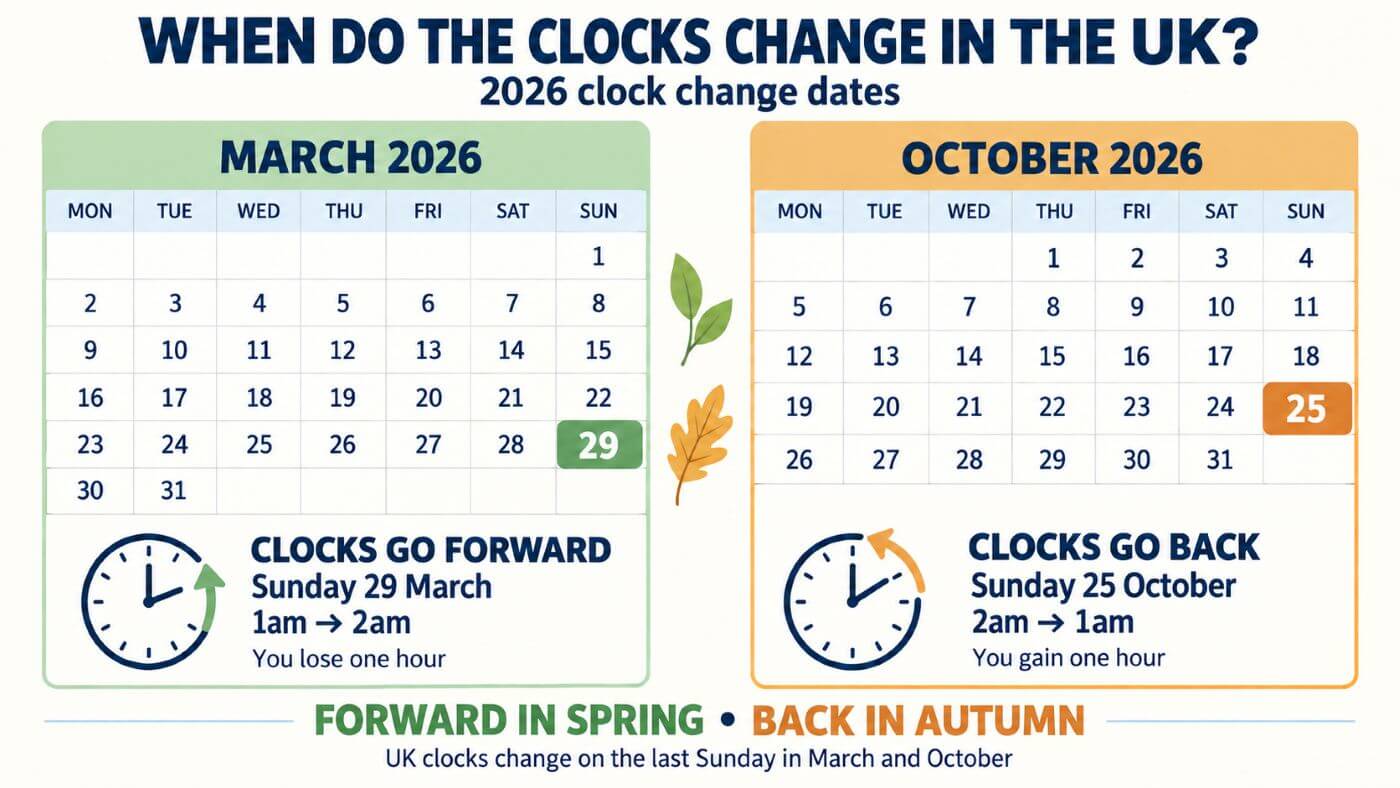
The next UK clock change takes place in the early hours of Sunday 25 October 2026.
At 2am British Summer Time, the clocks go back one hour to 1am. The UK then returns to Greenwich Mean Time for the winter.
That means Sunday 25 October effectively contains an extra hour. Sunrise and sunset will both occur about an hour earlier by the clock than they did the previous day.
Most smartphones, computers and other internet-connected devices should update automatically. Traditional watches, wall clocks, ovens, microwaves and some car clocks may still need changing manually.
Next UK clock change
Clocks go back on Sunday 25 October 2026
When: Sunday 25 October 2026. What happens: at 2am, clocks go back to 1am. Time zone afterwards: Greenwich Mean Time (GMT). Sleep: most people get an extra hour.
When do the clocks change in 2026?
The UK changes its clocks twice each year.
The clocks already went forward on Sunday 29 March 2026, beginning British Summer Time. They next go back on Sunday 25 October 2026, returning the UK to Greenwich Mean Time.
UK clock change dates
| Clock change | 2026 date | What happens? | Result |
|---|---|---|---|
| Clocks go forward | Sunday 29 March 2026 | 1am becomes 2am | British Summer Time begins |
| Clocks go back | Sunday 25 October 2026 | 2am becomes 1am | Greenwich Mean Time returns |
The rule is consistent even though the numerical dates change. In the UK, the clocks go forward on the last Sunday in March and go back on the last Sunday in October.
Do the clocks go forward or back in October?
They go back.
At 2am on Sunday 25 October 2026, the clock returns to 1am. The hour between 1am and 2am therefore occurs twice.
The familiar American way of remembering the direction is:
Easy way to remember
Spring forward, fall back
Spring: clocks go forward by one hour. Autumn: clocks go back by one hour. In the UK that means forward in March and back in October.
Do we get an extra hour in bed when the clocks go back?
In principle, yes.
Because the clocks repeat the hour between 1am and 2am, most people sleeping through the change have an extra hour available before reaching the same clock time in the morning.
It is the opposite in March. When the clocks go forward from 1am to 2am, an hour disappears from the clock and the night is effectively one hour shorter.
Not everybody benefits from the October change, of course. People working overnight can encounter an extra hour in their shift depending on their working arrangements, while parents of young children may discover that body clocks are considerably less interested in British Summer Time than smartphones are.
What happens if you are working a night shift when the clocks change?
The clock change can make a night shift one hour longer in October or one hour shorter in March, depending on how the employer schedules and records the shift.
This is most noticeable for people working overnight in hospitals, care homes, emergency services, transport, hospitality, security, manufacturing and other 24-hour operations.
Working overnight?
Do not assume the extra hour automatically means overtime
How a clock-change shift is paid depends on your pay arrangements, contract and workplace policy. Hourly-paid staff should check how actual hours are recorded, while salaried workers may have different contractual arrangements. Check with your employer, payroll team or union if the policy is unclear.
Do you get paid for the extra hour when the clocks go back?
There is no general rule that everyone working through the autumn clock change automatically receives an hour of overtime pay.
The answer depends on the employment contract, the worker’s normal hours, whether they are paid by the hour or receive a salary, and any overtime or collective agreement applying at the workplace.
Employers must still comply with minimum-wage requirements and applicable working-time rules. If an employee believes the additional hour has not been recorded or paid correctly, they should check their contract, timesheet and payslip and raise the issue with their employer or payroll team.
What happens to working-time limits?
The clock changing does not suspend the normal rules on working time and rest.
Under the Working Time Regulations, night workers are subject to specific limits. Acas says night workers must not normally work more than an average of eight hours in each 24-hour period, calculated over the relevant reference period. Stricter rules apply where night work involves special hazards or heavy physical or mental strain.
Workers are also generally entitled to rest between working days and to a rest break when working more than six hours, although there are exceptions and compensatory-rest arrangements for some shift-working situations.
If a clock-change night creates uncertainty about the length of a shift, employers should make the roster, time-recording and pay arrangements clear in advance.
What is British Summer Time?
British Summer Time, or BST, is the period when UK clocks are one hour ahead of Greenwich Mean Time.
It begins when the clocks go forward in March and ends when they go back in October.
During BST, the UK’s time is effectively GMT+1. Moving an hour of daylight from the morning towards the evening gives later sunsets according to the clock during the warmer months.
When BST ends in October, the UK returns to Greenwich Mean Time, or GMT.
| Period | UK time | What it means |
|---|---|---|
| Late March to late October | British Summer Time (BST) | GMT+1 |
| Late October to late March | Greenwich Mean Time (GMT) | GMT |
Why do the clocks change in the UK?
The basic idea is to make better use of daylight during the longer days of spring and summer.
Britain’s best-known early campaigner for changing the clocks was builder William Willett. In 1907 he published The Waste of Daylight, arguing that people were sleeping through useful daylight on summer mornings while having less daylight available for recreation later in the day.
His original proposal was more complicated than the system used today. Willett wanted clocks to move forward gradually in a series of smaller changes.
Parliament considered proposals for summer time before the First World War, but they were repeatedly rejected.
The situation changed during the war. Britain introduced summer time in 1916, following Germany and other countries, with arguments including better use of daylight, economic productivity and reduced fuel consumption.
Willett did not live to see the change. He died in 1915.
The principle survived, although Britain’s clock arrangements have changed several times since.
| Year | What happened? |
|---|---|
| 1907 | William Willett publishes The Waste of Daylight and campaigns for summer clock changes |
| 1908 | A parliamentary attempt to introduce a summer clock change is rejected |
| 1916 | Britain introduces summer time during the First World War |
| Second World War | Britain uses British Double Summer Time during part of the war |
| 1968–1971 | Britain experiments with keeping clocks advanced through the winter |
| Today | Clocks go forward on the last Sunday in March and back on the last Sunday in October |
Did Britain ever put the clocks forward by two hours?
Yes.
During the Second World War, Britain used what became known as British Double Summer Time.
During the relevant summer period, clocks were two hours ahead of Greenwich Mean Time. During winter they remained one hour ahead rather than returning to GMT.
The arrangement was introduced as part of wartime efforts to make greater use of daylight and increase productivity.
Britain later returned to the more familiar GMT and British Summer Time system.
Did the UK ever stop changing the clocks?
For a limited period, yes.
Britain experimented with keeping clocks one hour ahead of GMT throughout the year between 1968 and 1971.
That meant the clocks were not put back to GMT during those winters.
The experiment was ultimately abandoned and the UK returned to seasonal clock changes.
Why is UK winter time called Greenwich Mean Time?
The answer lies in Greenwich’s historic role in astronomy, navigation and timekeeping.
Before standardised time, towns around Britain could keep their own local time based on the Sun. That became increasingly impractical as railway travel expanded during the 19th century.
Railway companies increasingly adopted Greenwich Mean Time to create a common timetable across the country. By the 1840s, most railway companies were using GMT.
Greenwich time became Britain’s legal standard in 1880, while the International Meridian Conference of 1884 established the Greenwich meridian as the international Prime Meridian.
It’s named as the 0° longitude prime meridian runs through Greenwich in London.
GMT is the same time-zone as Coordinated Universal Time (UTC), the primary international time standard used to regulate clocks and synchronize time across the world.
A clock that does not change
The Royal Observatory keeps its historic clocks on GMT
Visitors to Greenwich in summer can be surprised to see some Observatory clocks apparently one hour slow. They are deliberately kept on Greenwich Mean Time rather than being moved forward for British Summer Time.
Will my phone change automatically?
Usually, yes.
Smartphones, tablets and computers set to update their date and time automatically should change without the owner doing anything.
Many smart televisions, watches and connected household devices will do the same.
Older or manually controlled clocks may still need attention. The easy ones to forget include:
- Oven and microwave clocks
- Wall and mantel clocks
- Traditional watches
- Alarm clocks that are not radio-controlled or internet-connected
- Some central-heating and hot-water timers
- Older car clocks
- Timers used for lights or other household equipment
If an alarm, journey or appointment matters on the Sunday morning of the clock change, check the device rather than simply assuming it has updated.
What happens to trains and public transport when the clocks change?
The change is deliberately made in the early hours of Sunday morning to minimise disruption, but overnight services still have to account for the repeated or missing hour.
Passengers travelling overnight should use the timetable and time printed by the relevant operator rather than trying to calculate the change themselves.
This is particularly important in October because the period between 1am and 2am occurs twice. Transport operators, airlines and computerised booking systems distinguish between the relevant times when scheduling services.
When do the clocks change in 2027?
The same last-Sunday rule continues next year.
| Year | Clocks go forward | Clocks go back |
|---|---|---|
| 2026 | Sunday 29 March | Sunday 25 October |
| 2027 | Sunday 28 March | Sunday 31 October |
| 2028 | Sunday 26 March | Sunday 29 October |
Are the UK clock changes going to be abolished?
There has been repeated debate about whether changing the clocks twice a year should continue, but the UK still operates British Summer Time and Greenwich Mean Time and there is no current change to the published 2026, 2027 or 2028 timetable.
Arguments for changing the clocks have included lighter summer evenings, opportunities for outdoor leisure and potential road-safety or economic benefits.
Arguments against include the disruption of changing time twice a year, darker winter mornings under alternatives that retain summer time, and questions over whether the original energy-saving case remains relevant to modern patterns of work and energy use.
There was also considerable discussion around European proposals to end seasonal clock changes. That did not result in the UK abandoning its existing system.
No change for 2026
The clocks are still going back this October
Whatever you may have seen in older stories about proposals to abolish clock changes, the UK government’s current calendar confirms that the clocks go back on 25 October 2026, forward on 28 March 2027 and back again on 31 October 2027.
Frequently asked questions
When do the clocks go back in 2026?
The clocks go back on Sunday 25 October 2026. At 2am British Summer Time, the clocks move back one hour to 1am Greenwich Mean Time.
When do the clocks go forward in 2027?
The next spring clock change is on Sunday 28 March 2027, when the clocks go forward by one hour at 1am.
Do you gain or lose an hour when the clocks go back?
You gain an hour. When the clocks go back in October, the hour between 1am and 2am effectively occurs twice as the UK returns from British Summer Time to Greenwich Mean Time.
Do you lose an hour when the clocks go forward?
Yes. In March, the clocks jump forward from 1am to 2am, so there is one fewer hour during that night.
What is the difference between GMT and BST?
Greenwich Mean Time (GMT) is used in the UK during the winter. British Summer Time (BST) is one hour ahead of GMT and applies between the spring and autumn clock changes.
Do the clocks change at midnight?
No. In the UK, the spring change happens at 1am, while the autumn change occurs at 2am British Summer Time, when the clock returns to 1am Greenwich Mean Time.
Will my phone change automatically?
Normally, yes, provided automatic date and time settings are enabled. Smartphones, computers and many internet-connected devices usually update automatically. Traditional clocks, watches, ovens, microwaves and some car clocks may still need changing manually.
What happens if I work the night shift when the clocks go back?
You may be at work for an additional actual hour because the clock moves from 2am back to 1am. Whether that produces additional pay or overtime depends on your contract and workplace arrangements. Employers must still comply with applicable minimum-wage and working-time rules.
What happens if I work the night shift when the clocks go forward?
A shift covering the spring change can contain one fewer actual hour because the clock moves directly from 1am to 2am. How this affects pay depends on the worker’s contract, pay method and employer policy.
Do all countries change their clocks?
No. Daylight-saving arrangements vary around the world. Some countries change their clocks on different dates and many do not change them at all, so international time differences can temporarily alter during spring and autumn.
Do the Channel Islands and Isle of Man change their clocks too?
Yes. The Crown Dependencies use the same seasonal clock pattern as the UK, moving between Greenwich Mean Time and British Summer Time.
Are the UK clock changes going to be abolished?
The current UK system remains in place. The official government timetable continues to list spring and autumn clock changes, so people should not assume that seasonal clock changes have ended unless the law is formally changed.
UK clock-change dates and current working-time guidance checked on 9 September 2026. Employment contracts and workplace agreements can differ, so workers should check their own terms where a clock change affects shift length or pay.
You May Also Be Interested In