



















South East Water has removed a range of exemptions from its Sussex hosepipe restrictions, with changes affecting households and some businesses from Friday 9 October.
People who previously had permission to use a hosepipe are being urged to check the rules again as South East Water tightens its restrictions in Sussex.
The changes took effect at 12.01am on Friday 9 October 2026. They affect water supplied by the company in its Sussex supply area, rather than every household across the county.
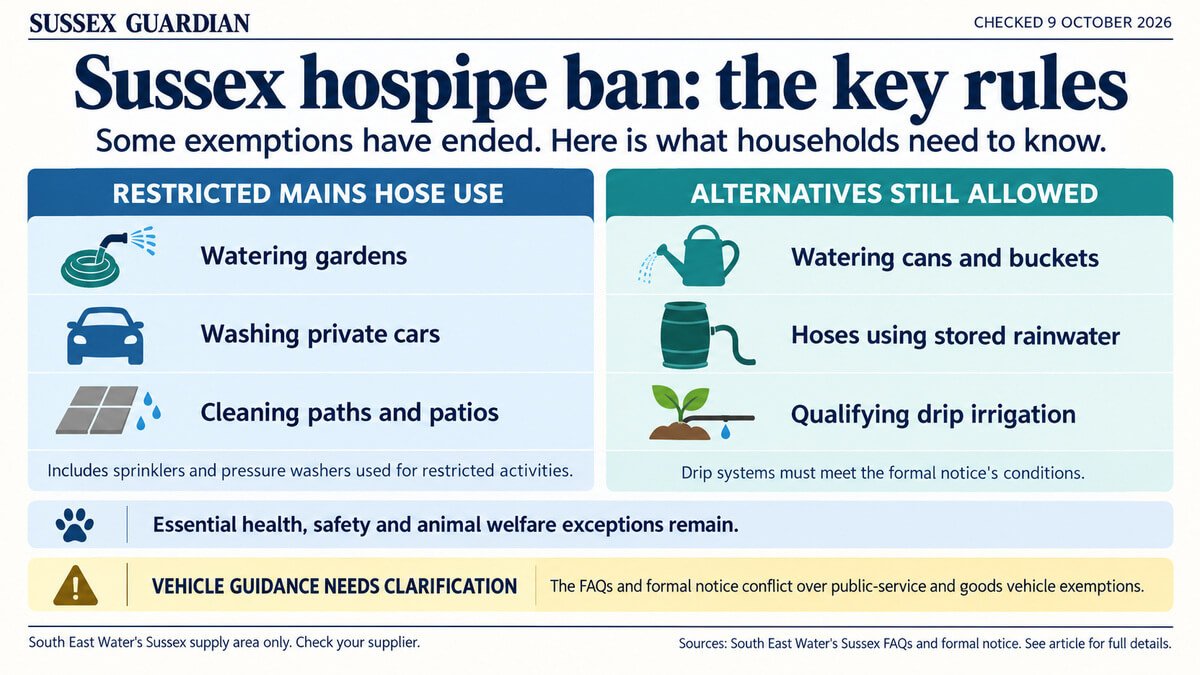
The existing hosepipe ban already restricts activities including watering gardens, washing private cars and cleaning patios with mains-fed hoses. Sprinklers and mains-connected pressure washers are also covered.
There is also conflicting advice in the company’s own documents about washing certain business vehicles, which we explain below.
| What has changed? | A range of previous exemptions has ended. |
|---|---|
| When? | Friday 9 October 2026, from 12.01am. |
| Who is affected? | Users of South East Water supplies in its Sussex area. |
| When will it end? | No lifting date has been announced. |
How do I check whether my home is affected?
Check who supplies your drinking water. Water UK has a postcode search showing water and wastewater providers, which can be different companies.
South East Water’s notice also covers its water supplied through other retailers or appointed suppliers. If another company bills you, check with it where your water comes from.
Which exemptions have ended?
South East Water’s Sussex guidance says being on its Priority Services Register no longer provides a general exemption. An essential health or safety reason may still permit a particular use, but registration alone does not.
Previous age-based exemptions have also ended. Newly laid domestic lawns cannot be watered with an ordinary mains-fed hose, although permitted alternatives remain available.
For gardeners, watering cans and buckets can still be filled from a tap. A hose connected to stored rainwater can also be used, but filling a water butt with a mains-fed hose does not get around the restrictions.
What can I still use?
The formal restriction notice retains several exceptions. These include essential health and safety uses and specified methods of watering.
| Activity or equipment | Position under the Sussex rules |
|---|---|
| Ordinary hose or sprinkler for a garden | Restricted when using the company’s mains water. |
| Watering can or bucket | Permitted for watering plants. |
| Hose connected to stored rainwater | Permitted. |
| Drip or trickle irrigation | Permitted if it meets the notice’s equipment and operating conditions. |
| Essential health, safety or animal welfare use | Exceptions remain, including protecting fish and other animals. |
Qualifying irrigation must have a timer and pressure-reducing valve, must not be handheld, and must deliver water directly onto or beneath the soil without surface run-off, spray or mist.
Are businesses affected too?
Some are. South East Water says exemptions for commercial hosepipe cleaning of domestic properties have been removed. This affects services such as window and patio cleaning unless a relevant health or safety exception applies.
A separate proposed Non-Essential Use Ban, covering further commercial and non-household activities, is still an application. It requires government approval and the company says it would implement it only if drought conditions worsen.
Businesses should therefore check the rules for their particular activity: the pending application does not mean all commercial uses remain exempt from today’s changes.
Conflicting advice on vehicle washing
South East Water’s business FAQs say hosepipe cleaning of public-service and goods vehicles is no longer permitted. However, page three of the formal notice linked from the same page still lists statutory exemptions for those categories.
The notice refers to specific legal definitions of public-service and goods vehicles. It should not be read as a general exemption for every vehicle used by a business.
The two passages were checked by Sussex Guardian on 9 October. Clarification is needed from South East Water on which guidance operators should follow and whether either document needs correcting. Anyone affected should ask the company or their water retailer about their particular vehicle and activity.
Why are restrictions continuing into October?
South East Water says Sussex received just over 56% of its expected rainfall between March and August. Its drought update says recent rain has helped, but sustained rainfall is needed to replenish rivers, reservoirs and underground water sources.
The company’s latest published reservoir figures available when this article was checked were dated 27 September: Ardingly was 22.8% full and Arlington 49.2% full. Those are September readings, rather than measurements taken today.
The reservoirs are normally replenished between October and April, using water from the River Ouse at Ardingly and the River Cuckmere at Arlington.
Alongside asking customers to use less, the company says it repaired 893 leaks in Sussex between April and August and increased repair teams from 14 to 21. It has also accelerated work to move treated water from Bewl in Kent into the East Sussex network.
No end date has been announced. Consumer body CCW advises checking the rules with your supplier and says breaching a hosepipe ban can result in a fine of up to £1,000.